Star Frontiers
Alpha Dawn — Expanded Game Rules
A Science Fiction Game from the Producer of DUNGEONS & DRAGONS
Design: TSR Staff | Editing: Steve Winter | Cover Art: Larry Elmore
Introduction
This is the STAR FRONTIERS Expanded Game rule book. This book adds more details to the Basic Game rules, and introduces new rules that widen the game's scope and make the game more challenging and more fun to play. If you have not read the Basic Game rules and played the basic adventures, you should do so before starting to read these Expanded rules.
What is a Star Frontiers Game?
STAR FRONTIERS Science Fiction Game is a role playing game. In this type of game, each player controls an imaginary hero, making all his decisions and guiding him through heroic exploits: defeating villains, capturing criminals and exploring strange alien worlds.
Although the STAR FRONTIERS rule books contain detailed rules, the special quality of a role playing game is that players are not limited by the rules. Players are encouraged to use their imaginations and find creative solutions to the problems facing their characters. The rules are designed to help players see the effects of their decisions.
Differences Between the Basic and Expanded Rules
The Expanded Game rules give more detailed explanations of character abilities, new rules for movement and combat, new equipment, and rules that allow characters to improve their ability scores and learn special skills.
The most important change in the Expanded game is the addition of a referee. A referee does what the reader did in the Basic Game, but he also creates the adventures and makes the final decisions about how the rules should be applied. If players are the citizens of a world in the future, then the referee is that world; he writes the laws, he creates the unexplored planets and alien races, and he controls everyone that is not a player character. The referee has the most important job in the game.
Because his job is so important, this book was written especially for the referee. It not only explains the rules, but teaches the referee how to apply the rules to special situations and how to handle situations that are not covered by any rules. Other sections on how to create adventures and how to control non-player characters are very important for novice referees.
The separate adventure, Crash on Volturnus, will help a new referee get started. It is intended to help the referee learn the expanded rules.
Anyone who has played STAR FRONTIERS game and is familiar with the rules can be a referee. If you like telling stories, springing surprises and making fast decisions, you will have a lot of fun as a STAR FRONTIERS game referee.
How to Use the Components
To play a STAR FRONTIERS game you need these rules, two 10-sided dice, the map and counters included with the game, pencils, paper, a place to play, and your imagination.
Dice
STAR FRONTIERS games use percentile dice. To roll percentile dice (abbreviated d100), roll both 10-sided dice. One die is the tens digit, the other is the ones digit. A roll of 0 and 5 = 05. A roll of 0 and 0 = 100 (not zero).
Counter Facing
Players can use the counters to indicate which direction a character, creature or robot is looking. The top of the picture on the counter indicates which side is the character's front. Players can imagine the character standing upright on the counter, facing toward the top of the counter.
A character can see anything that is not behind him. He can attack anything that is in front of him, and can defend himself from any attack that comes from the front or the side.
Maps
Seven small maps showing different types of terrain are printed on the back of the Port Loren map. These were drawn for the Crash on Volturnus adventure, but they can be used in any adventure calling for that type of terrain.
Map Scales
In the Basic Game, distances were stated in terms of squares on the map of Port Loren. In the Expanded Game, distances are measured in meters. This makes it easy to play the game on maps with different scales. A referee could map the inside of a building using a grid of 2 meters per square, map a city using a grid of 5 meters per square, and map the area around the city using a scale of 25 meters per square.
Players can draw maps with much larger scales, showing entire continents or even planets. These types of maps are used when characters must travel a long distance. The planetary map from Crash on Volturnus is this type of map.
If the size of a map square does not divide evenly into a character's movement rate, counters can be placed on the lines between squares.
Playing Without a Map
STAR FRONTIERS combats can be played on a table top, without using maps. Pieces of paper or other items can be used to show furniture, doors and other obstacles. Another possibility is to play on a sheet of plastic, using wash-away markers to draw obstacles on the plastic. Distances can be measured with a ruler; 1 inch should equal 5 meters.
Miniatures
Instead of using counters, players can use small metal or plastic figures painted to look like their characters. These can be purchased in many toy and hobby stores.
Imagination
After they are familiar with the game, players may decide it is easier to play simple fights without the maps and counters. The referee simply keeps track of ranges and obstacles in his head, and lets the players picture the situation in their imaginations. Besides being a lot of fun, this eliminates the need to draw a map for everything.
Dice Rolls
Some rules in the Expanded Game use a 5-sided die (abbreviated d5) to roll a number from 1 to 5. When a d5 roll is called for, the player should roll 1d10 and divide the result by 2, rounding fractions up. For example, a 6 becomes a 3 and a 7 becomes a 4.
Expanded Game Characters
Character generation is a bit different in the Expanded Game. A player can change his character's Ability scores when he generates his character. He can also choose from other abilities in the game. Some races have special abilities that are unique to their species.
How to Create a Character — Summary
- Use the STAR FRONTIERS character sheet, or make a copy on a blank sheet of paper.
- Roll d100 once for each ability pair. Find the ability base score on the table below.
Ability Score Table
| Dice Roll | 01-10 | 11-20 | 21-35 | 36-55 | 56-70 | 71-80 | 81-90 | 91-95 | 96-00 |
|---|---|---|---|---|---|---|---|---|---|
| Base Score | 30 | 35 | 40 | 45 | 50 | 55 | 60 | 65 | 70 |
- Decide which race your character will be. Add or subtract the racial modifiers from the Ability Modifier Table.
Ability Modifier Table
| Race | STR/STA | DEX/RS | INT/LOG | PER/LDR |
|---|---|---|---|---|
| Dralasite | +5 | -5 | +0 | +0 |
| Human | +0 | +0 | +0 | +0 |
| Vrusk | -5 | +5 | +0 | +0 |
| Yazirian | -10 | +5 | +5 | +0 |
- If the character is a Human, the player can add 5 points to any one ability score. These points apply to only one ability, not to both abilities in a pair.
- Players now can modify their ability scores by subtracting points from one ability and adding them to their other ability in that pair. No more than 10 points can be shifted this way.
- Divide the character's Reaction Speed score by 10 (round up) to get the initiative modifier. The final result is the character's Initiative modifier (IM).
- Non-Human characters have special abilities that should be noted on the character sheet. These special abilities are listed below. For more details, see the descriptions of the various races.
Dralasites: Lie Detection (5%), Elasticity
Vrusk: Comprehension (15%), Ambidexterity
Yazirians: Battle Rage (5%), Gliding, Night Vision
- If the character is a Human or Yazirian, decide whether he is right or left handed. Dralasites and Vrusk do not choose handedness, see their racial descriptions for more information.
- Decide whether the character is male or female (unless it is a Dralasite) and give it a name.
Ability Checks
During STAR FRONTIERS games, players will want their characters to try doing many different things. It would be impossible to state rules covering every possibility. Instead, this section describes a very simple rule that can be used in almost any situation.
When a character tries to do something that is not covered by a specific rule, the referee should decide whether the action is something the character can do automatically or if there is a chance the character might fail. If the action is not something the character can do automatically, then the character must make an ability check. The referee decides which of the character's abilities is most important in performing the action. The player rolls d100 and, if the result is equal to or less than the ability score the referee chose, then the character succeeded at whatever he was trying to do.
Modifiers
The referee may decide an action is easier or harder than average because of an unusual situation. When this happens, the referee can tell the player to adjust his character's ability score by adding or subtracting a number, making the ability check easier or harder to pass. Most modifiers should not be more than plus or minus 30.
Secret Checks
If knowing the result of an ability check will give a player something his character would not know, the referee should make the check secretly and tell the player only what his character sees, or what happens to the character.
Ability Uses
All eight character abilities are listed below, along with examples of tasks that would require an ability check against that ability.
Strength
Strength determines a character's chance to break open doors, bend metal, shift heavy objects or anything else requiring brute force.
Stamina
A character's Stamina score is the number of points of damage the character can take before being killed. It is the character's percent chance to resist the effects of poison, gas, drugs, disease, extreme heat or cold, starvation and fatigue.
Dexterity
A character's Dexterity score determines his base chance to hit in combat. It also is his percent chance to sense things by touch, throw or catch an object, keep his balance, jump into a moving vehicle or perform delicate actions like cutting a wire without touching any surrounding wires.
Reaction Speed
A character's Reaction Speed score is his percent chance to react quickly, to avoid falling rocks, to catch something he knocked over before it hits the floor, to jump away from a skimmer that is racing toward him, to grab an animal or to dive through a door before it slams shut.
Intuition
A character's Intuition score is his percent chance to notice small details or hidden objects, to sense an ambush or trap and, at the referee's discretion, to make sense out of seemingly unrelated or illogical facts. When a character passes an Intuition check, the referee should tell the player that he notices something unusual, and describe what the character sees (or hears, smells, feels or tastes). The player must decide what to do with this information. Referees should urge players to figure out puzzles on their own; Intuition checks should not be allowed until after the players have tried (and failed) to solve the puzzle themselves.
Logic
A character's Logic score is his percent chance to follow complicated instructions, to figure out the best way to do something he has never done before or use something he is not familiar with, and to make accurate predictions from facts. The referee should roll Logic checks secretly. If the character fails the check, the referee can tell him either that he does not understand whatever he was studying, or can give him false information. A character's Logic score can be modified by the complexity of the situation and the amount of time the character spends studying it. The referee should encourage players to draw their own conclusions from information; like Intuition, Logic checks should be a last resort.
Personality
Personality affects how likely a character is to get a friendly response from a stranger and how long he can hold someone's attention. The referee should encourage players to role-play their attempts to use Personality and talk to NPCs.
Leadership
A character's Leadership score reflects his ability to command with authority and have NPCs obey his orders. Leadership checks are needed only if a character orders an NPC to do something dangerous, or has mistreated the NPC. Under normal conditions, NPCs who work for a character will always obey that character. If characters try to give orders to strangers, the referee must decide how likely the stranger is to obey.
Leadership also is used to bargain with NPCs. The referee should not let characters with high Leadership scores trade junk for valuable merchandise, but a successful Leadership check will get a better deal for the character, or convince reluctant NPCs to deal with the character. Characters can bargain for information as well as merchandise.
More information about the effect of Leadership on NPCs can be found in the section on NPCs.
Improving Characters
Characters can increase their ability scores, and racial abilities, and gain skills through adventuring. As characters adventure, they learn from their experiences and improve themselves through practice. In STAR FRONTIERS games, this type of experience is recorded with experience points (XP). The referee hands out experience points at the end of an adventure to reward characters' performance and success. If a character performed beyond the expectations of his employer, he will receive more experience. If he failed miserably at his task, he will receive less experience.
Improving Abilities
Players can increase their characters' ability scores by trading 1 XP to raise an ability score 1 point. No ability score can ever be raised above 100.
Certain Racial Abilities (Lie Detection, Comprehension and Battle Rage) also can be increased by trading 1 XP to increase the ability 1 point. Racial Abilities cannot be raised above 100.
Obviously, increasing a character's ability scores will improve his chances to perform special actions, will improve his chances to hit in combat by increasing Dexterity, and will increase his chances to survive by increasing his Stamina. Raising ability scores also can replace points lost permanently to disease or tissue deterioration in a freeze field.
Skills
Characters can learn skills which allow them to perform special actions. Each skill has six levels of expertise. A character can raise his skill levels by spending experience points. Experience points can be traded to gain a level 1 skill or to increase a skill the character already has to the next level. The number of XP that must be traded for each skill and skill level is described in the SKILLS section.
The Races
The five major races in the Frontier are described on the following pages. Players can choose to have Dralasite, Human, Vrusk or Yazirian characters. Sathar should be NPCs only.
These five races are not the only intelligent races living in the Frontier; there are many other races native to planets in the area. However, these five are the only races that have managed to build starships and explore and colonize other worlds.
Dralasites
Physical Appearance and Structure
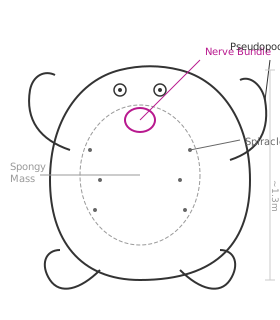
Dralasites are short, rubbery aliens that have no bones or hard body parts. Their skin is a flexible membrane that is very tough and scratchy. It generally is dull gray and lined with dark veins that meet at the Dralasite's two eyespots.
The internal structure of a Dralasite is very different from the other races. The Dralasite's central nerve bundle (brain), numerous small hearts and other internal organs float in a pudding-like mixture of protein and organic fluids. Dralasites breathe by absorbing oxygen directly through their skin, so they have no lungs. They are omnivores, but eat by surrounding their food and absorbing it, so they also have no digestive tract or intestines.
All Dralasites go through male, female and neutral stages during their lives (these phases can be controlled with medicines). Males release spores into the air, which drift until they become attached to a female. A young Dralasite then "sprouts" from its mother, eventually maturing and dropping off.
Senses
The most important sense for a Dralasite is smell. They breathe directly through their skin, and the entire membrane is sensitive to odors. Their sense of smell is so keen they can identify persons by smell alone and can recognize familiar smells on objects or persons. The membrane also is sensitive to touch and to vibrations, allowing Dralasites to hear and feel.
Dralasites see only in black and white. They see shapes and light and darkness very clearly, and can see a difference between distinct colors (blue and green, for example) because one is darker than the other, but they do not see actual colors.
Speech
Dralasites have a voicebox, but it works like a bellows because they have no lungs. A Dralasite's voice can vary from a soft whisper to a thundering roar and from a bass rumble to a piercing screech. Among themselves, they also use shapes, odors and touch to communicate.
Society and Customs
Dralasites are philosophical and thoughtful. Their communities are small, and many Dralasites prefer to live alone. Dralasites do not care about wealth, power or status symbols. They judge themselves by the quality of their ideas and their ability to discuss important ideas wisely. Dralasites often hold large public meetings to discuss new ideas. Discussions and debates are among their favorite ways to relax.
Steam baths are another favorite Dralasite recreation. They mix perfumes and intoxicants with the steam. These effect Dralasites the same way alcohol does a Human or Yazirian.
Dralasites are widely known for their strange sense of humor. They love old jokes and puns that make Humans groan. Many Human comedians who could not find work in Human cities have become rich performing on Dralasite worlds.
Dralasites do not normally wear clothing, because it makes breathing difficult and interferes with their sense of smell. They usually carry their equipment on web belts. When they must wear clothing to protect themselves, they use special materials that let air reach their skin.
Attitudes
Dralasites are very fond of Vrusk, because they think Vrusk have funny shapes. They get along well with Humans but are careful not to upset Yazirians, who they consider too violent.
Special Abilities
Elasticity. A Dralasite's skin is stretchable and supported by a complex muscle structure. This allows them to change the shape of their bodies, within limits. They can "grow" arms and legs to use for walking and handling tools and weapons, and reabsorb limbs when they are not needed.
A Dralasite can have a number of limbs equal to its Dexterity divided by 10, rounded up. The player must decide whether a limb is an arm or a leg when it is grown. For example, a Dralasite with a Dexterity score of 45 can control up to five limbs. It could have three legs and two arms, two legs and one arm, no legs and five arms, or any other combination adding up to five or less.
Growing or absorbing a limb takes five minutes. Only one limb can be grown at a time. A limb can be up to 1 meter long, and no less than 10 cm thick. "Fingers" for handling items can be up to 10 cm long and no less than 1 cm thick.
Even though a Dralasite can have many arms, it can not fire more than two weapons at once. When a Dralasite player creates limbs, he must specify one as the dominant limb, the same way a Human must choose to be either right or left handed. Also, despite a Dralasite's stretching and shrinking, the pattern of veins and ridges on its skin does not change, so they have a permanent "fingerprint" for identification.
Lie Detection. All Dralasite characters have a 5% chance to realize when someone is lying to them. The Dralasite must be communicating face to face with the character, and the Dralasite player must tell the referee he is trying to detect a lie. The referee rolls d100 secretly; if the result is 5 or less, the Dralasite knows whether the person is telling the truth. If the die roll is 6 or more, the Dralasite does not sense that the person is lying. This special ability can be improved above 5% by spending experience points (see IMPROVING CHARACTERS).
- Average Size
- 1.3 m tall, 1 m wide
- Average Mass
- 65 kg
- Average Lifespan
- 250 years
- Reproductive System
- hermaphroditic, budding
- Body Temperature
- 30°C
Humans
Physical Appearance and Structure
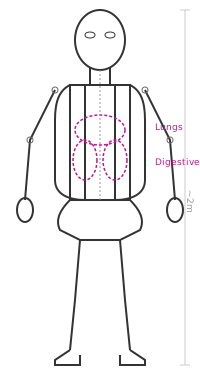
Typical adult Humans are approximately 2 meters tall, and have two arms and two legs. They are warm-blooded omnivores with internal skeletons. Both hands have four fingers and one opposable thumb, which allows them to grip and use tools. Their arms are jointed at the shoulder, elbow and wrist. Their legs are similar, being jointed at the hip, knee and ankle. Humans walk upright.
Human skin color varies over a wide range, including pale white and pink, tan, pale yellow, red, brown and black. This color does not change as the Human matures. Most Humans have hair covering the top and back of the head, and males also have hair on their chins and throats. Hair color varies from white and yellow to red, brown and black, gradually changing to gray as the Human ages.
Senses
Humans have color vision, sensing the spectrum between infrared and ultraviolet wavelengths. They have good depth and motion perception. Their hearing covers a range from 16 to 27,000 cycles per second, with good separation and direction-sensing qualities. Their skin is touch-sensitive. Their senses of taste and smell are not as highly developed as their sight.
Speech
Humans speak by forcing air from their lungs through a larynx or voicebox and shaping sounds with their lips and tongue. They can create a wide range of sounds, and have no difficulty speaking Pan-Galactic and Yazirian languages.
Society and Customs
Human society centers around the family. A family generally consists of a father, a mother and 1 to 10 children. Families usually group together into communities for mutual support and protection. Community size varies widely; several Human cities are known to have populations above 5 million.
On all the core Human planets, Humans are the most imaginative and adaptable of the races. More alien creatures have found the most new land and have met the most philosophical challenges. Humans tend to be pushy and noisy, sometimes putting their own personal and social freedom to work together in most cultures and in a variety of professions.
On a large scale, Human society is as fractured as that of any other species. Humanity races among itself, makes war against itself, and would have destroyed itself if not for the discovery of other intelligent races and the technology to colonize new worlds.
Attitudes
Humans are one of the most open and accepting of the known races. As such, they have become something of a "glue" in the UPF, building bridges between races and overlooking many cultural faults. A strong enough to welcome the social structures of other races, yet innovative enough to not be dominated by them. Perhaps because of this, Humans have become the most numerous race in Frontier territory.
Special Abilities
Humans receive additional training and education more than other races. If a Human character is going to start the game with a skill, the player should increase the ability score of one ability (not a pair) by 5 points. This cannot increase the ability score above 100.
- Average Size
- 2 m tall
- Average Mass
- 80 kg (male), 60 kg (female)
- Average Lifespan
- 200 years
- Reproductive System
- heterosexual, viviparous
- Body Temperature
- 37°C
Vrusk
Physical Appearance and Structure
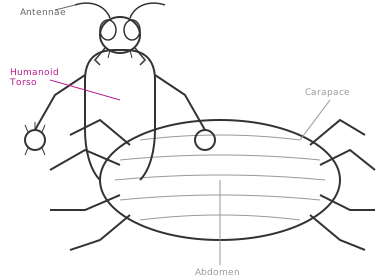
Vrusk look like large insects. Eight legs grow from their abdomens, four on each side. Their torso is upright in front of the abdomen. The torso is humanoid, with two arms connected at the shoulders. The head is above the shoulders. Vrusk hands are circular pads with five fingers spaced evenly around the edge. A Vrusk's shoulders are double-jointed, so they can rotate their arms in a full circle without straining any muscles. They can reach any point on their abdomen or behind their back easily.
A Vrusk's body is covered by a carapace (hard shell). This shell is jointed at the Vrusk's elbows, hips, knees, etc. The carapace protects the Vrusk from bruises, cuts, scratches and other minor injuries. Unlike insects, Vrusk have an internal skeleton to support their bodies. Young Vrusk have a blue carapace with bright orange near the joints. As the Vrusk gets older, its carapace changes to dull green with yellow joints.
Vrusk have large eyes that are protected by a hard clear covering. The mouth is surrounded by four eating mandibles. The two larger mandibles hold food while the two small ones tear it apart and place it in the mouth. They are omnivores. Vrusk have lungs, and breathe through many small nostrils under their abdomens. This arrangement makes it difficult for Vrusk to swim.
Senses
Vrusk have very good color vision, but they see more of the short wavelengths (blue and ultraviolet light) than Humans do, and less of the long wavelengths (orange and red). Their sense of smell is centered in their antennae, and is slightly better than a Human's. They also can touch with their antennae. Their hearing is about the same as a Human's.
Speech
Vrusk speak by combining clicks produced by their mandibles and buzzes produced by a plate in their mouths.
Society and Customs
Vrusk are hard-working and practical. Their society is organized around independent corporations. To a Vrusk, the company he works for is his family and his nation. The company determines everything about the Vrusk's life; who he lives with, what his job is, where he travels, etc. Vrusk give their company name before their personal name.
Vrusk have two types of corporations: conglomerates and trade houses. Conglomerates have business interests in many areas. A single conglomerate might have divisions that build computers, operate farms, train lawyers and set up colonies. A Vrusk that works for a conglomerate usually works for only one division, and might not even know what other divisions the company owns. Trade houses, which are more common in the Frontier, specialize in one type of business. Because all Vrusk working for a trade house do the same work, trade houses usually work together. For example, a trade house that builds farming equipment would hire accountants from an accounting house to keep their financial records. Business between companies is regulated by laws that are so complex no one besides Vrusk have ever fully understood them.
Vrusk also love beauty, harmony and order. The goal of most Vrusk is to become wealthy, collect art and live in peace. Their love for beauty makes them unwilling to get into fights that do not involve their company. However, Vrusk that are defending their company will do anything to remove the threat permanently.
Vrusk adventurers, however, do not belong to a company. Some are independent businessmen, some are company employees who were fired and some are just too rebellious to put up with company rules. A few start their own companies and eventually become leaders in their communities.
Attitudes
Vrusk get along well with the other three races. They respect the Yazirian custom of choosing a life-enemy, and feel at ease around Dralasites because they are careful and skillful planners (though they are annoyed by the Dralasites' sense of humor). They understand Humans the least because, to a Vrusk, Humans seem unpredictable and a little lazy.
Special Abilities
Ambidexterity. All Vrusk are ambidextrous (they can use both hands equally well). Players with Vrusk characters do not need to choose whether their character is right or left handed. Vrusk can shoot weapons, throw grenades, write, catch or grip with either hand.
Comprehension. Because Vrusk have such a complicated society, they are able to understand all sorts of social dealings. All Vrusk characters start with a Comprehension score of 15. This score is the character's percent chance to figure out any type of social dealing that the player himself can not. For example, a Vrusk is following a Human he thinks is a spy for another company. He follows the Human into a bar and sees him talking to a group of rough-looking Yazirians, occasionally glancing over his shoulder. Then the Human hands some money to the thugs and leaves the bar. The Vrusk player is not sure what the Human was trying to do, so he tells the referee he wants to use his Comprehension ability. If he rolls 15 or less on d100, the referee will tell him that the Human paid the Yazirians to attack the Vrusk if he tried to follow the Human from the bar. A character's Comprehension score can be increased by spending experience points (see IMPROVING CHARACTERS).
- Average Size
- 1.5 m tall, 1.5 m long
- Average Mass
- 85 kg
- Average Lifespan
- 175 years
- Reproductive System
- heterosexual, ovoviviparous
- Body Temperature
- 38°C
Yazirians
Physical Appearance and Structure
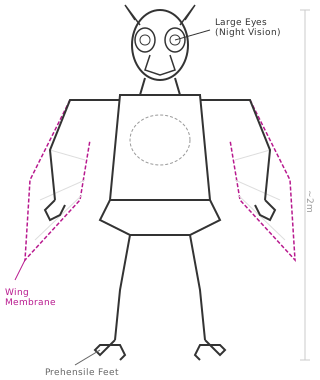
Yazirians are tall, thin humanoids. They have long arms and legs and slender torsos. Two large flaps of skin grow on either side of their bodies, attached along their arms, torso and legs. When a Yazirian raises its arms, this membrane is stretched tight and forms a sort of wing. Under certain conditions (explained under Gliding), Yazirians can glide short distances using these wings.
Yazirians have muzzles and high foreheads, giving them an animal-like appearance. Their heads are surrounded by manes and collars of hair, which varies in color from glossy black to pale yellow. Their skin color ranges from gray to light tan. Because their bodies do not sweat, Yazirians pant to keep cool. They are omnivores.
Yazirians have four knuckles (one more than Humans) on their fingers and toes. The inside toe is opposed like a thumb, allowing them to grasp things with their feet. The tips of their fingers and toes end in broad, ribbed pads, giving them an excellent grip. These characteristics, combined with their animal-like appearance, earned them the nickname "monkeys."
Senses
Yazirians' senses of hearing, smell and taste are equivalent to a Human's. Because they evolved from nocturnal hunters, however, their eyes are adapted to seeing in dim light. They can not see in complete darkness. They usually wear dark goggles when they must work in sunlight. In bright light, Yazirians without dark goggles must subtract 15 from both their Dexterity and Reaction Speed scores.
Speech
Yazirians have no trouble speaking Human languages or Pan-Galactic. Their own language is a combination of Human-type sounds and snarls and growls.
Society and Customs
Yazirian communities are divided into large, loosely organized clans. All the members of a clan are related to each other. In the past, clan ties were very strong. The clans had traditional enemies and allies, and they struggled constantly for power and land. Since the Yazirians moved into space, they have learned to cooperate more and the clans have become less important. Despite this, Yazirians still have a reputation throughout the Frontier as proud, fierce fighters.
A custom Yazirians have kept intact is the selection of a life-enemy. When a Yazirian chooses a life-enemy, he dedicates his life to destroying, overcoming or outdoing that enemy as completely as possible. In the past, a Yazirian would choose an enemy clan or clan member as his life-enemy, but now the choice is much wider. A Yazirian scientist could name an incurable disease as his life-enemy, or a Yazirian trader could choose a competing company. The scientist would try to find a cure for the disease; the trader would try to build up his own company so it is more powerful than his enemy's, or even try to drive the other company out of business.
A Yazirian gains honor by striving to defeat his enemy. Yazirians with powerful life-enemies are respected and admired. A Yazirian that defeats its enemy does not need to choose another, but some Yazirians do. There is no set point in a Yazirian's life when he must choose a life-enemy, and some Yazirians never choose one. A Yazirian that dies without having chosen a life-enemy is considered unlucky.
Typical Yazirian clothing is a large, brightly colored cape and tunic, a waist belt and two belts crossed over the chest. Dark goggles are worn in the daytime. Yazirians do not like shoes, but when necessary they wear mitten-like shoes.
Attitudes
In general, Yazirians like Vrusk and Humans. They occasionally lose their patience with Dralasites, because they are slow and would rather discuss ideas than act on them.
Special Abilities
Battle Rage. Yazirians train themselves to go berserk in battle. A berserk Yazirian gets a bonus of +20 to hit in melee. Yazirian characters start with a Battle Rage score of 5, and a 5% chance to go berserk at the start of a battle. This chance can be increased by spending experience points (see IMPROVING CHARACTERS) to raise the Battle Rage score. Battle Rage lasts as long as the Yazirian keeps fighting; it ends when the Yazirian rests for five minutes.
Gliding. Yazirians can glide short distances using the membranes along their sides. A Yazirian can glide 1 meter for every meter he is above the ground when he starts. He must start at least 10 meters above the ground. The maximum distance a Yazirian can glide depends on the gravity of the planet, as shown below.
| Gravity | Max. Glide |
|---|---|
| < .6 | 150 m |
| .6 - .9 | 100 m |
| .9 - 1.1 | 50 m |
| 1.1 - 1.4 | 25 m |
| 1.4+ | 10 m |
Yazirians cannot glide on planets with gravities below .6 or above 1.4.
- Average Size
- 2.1 m tall
- Average Mass
- 50 kg (male), 60 kg (female)
- Average Lifespan
- 140 years
- Reproductive System
- heterosexual, viviparous
- Body Temperature
- 39°C
Sathar
Note: Sathar should be used as NPCs only.
Physical Appearance and Structure
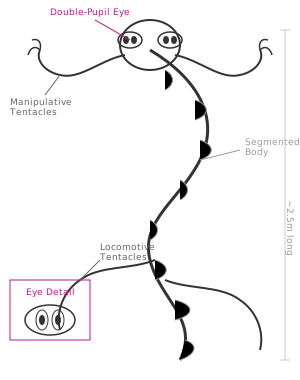
Sathar are long, worm-like creatures. Their bodies are divided into segments, like an earthworm's. They do not have a skeleton. Instead, they support their bodies hydrostatically, by pumping liquid into the segments so they become hard. A shiny, clear slime coats their skin. Scientists believe they are warm-blooded, but no live specimen has ever been studied.
A Sathar's head tapers toward its mouth, which is circular and ringed with teeth. Each of their two eyes has two pupils. Four tentacles, two on each side of the body, are arranged about 1 meter below the head. The first pair is slender and weak-looking, and about 1 meter long. These end in four smaller finger-like tentacles. The second pair of tentacles is stronger and about 1.2 meters long. Both of these tentacles end in a paddle-like pad. This second pair is used for heavy lifting, while the smaller tentacles are used for fine work and for holding small weapons.
A Sathar moves by slithering across the ground with the first meter of its body raised. They also can coil like a snake, raising 1.5 meters of their bodies from the ground.
The color of Sathar skin varies from yellow to brown. The tentacles are the same as the body, but with a slight greenish tint. The underbelly is pale pink. A pattern of dots, speckles and stripes decorates the back of the head. These patterns are natural on some Sathar, but are tattoos on others.
Some survivors of Sathar attacks have reported that Sathar are not affected by electrical shocks or doze grenades, but these reports have never been confirmed.
Senses
The Sathar's double pupils give it very wide angle vision. They can see objects in front of them and to both sides at the same time. They smell through two pits in front of their eyes. The sharpness of their senses is not known, but UPF biologists assume their hearing, smell and taste is about the same as a Human's.
Speech
Captured recordings show that Sathar can speak Yazirian and Human languages as well as Pan-Galactic. They hiss and lisp when they speak. Their native language has never been translated.
Society and Customs
Almost nothing is known about Sathar society. They have tried to kill every alien creature they have met in the Frontier, usually with alarming success. No one knows why the Sathar attack so viciously or what they hope to gain. All attempts to contact the Sathar peacefully have failed. No Sathar has ever been captured alive, because they kill themselves before they can be taken. In one case, an entire Sathar ship self-destructed to avoid being captured. Freeze fields have been applied to several dead Sathar in an attempt to have them revived, but biologists have not been able to find a revival technique that works on them.
Scientists have proposed several theories, based on reports from observers. The most widely accepted was written by Gdtlask Gitak, a Vrusk sociologist. Gitak's theory states that all Sathar belong to military units called cadres. The markings on the back of the Sathar's head identify its cadre. Each cadre trains its members as soldiers from the time they are born. Gitak theorizes that Sathar attack alien worlds because their military society would fall apart if there was no enemy to fight.
Readers are warned that this is only a theory. Until a Sathar is captured alive, their true motivation will not be known.
Attitudes
All Sathar should be considered hostile and dangerous. Citizens of the Frontier who encounter Sathar are required by law to report the incident immediately. If escaping is impossible, citizens are advised to attack on sight, as friendly approaches have always failed in the past.
Sathar also are known to use Dralasite, Human, Vrusk and Yazirian agents to overthrow Frontier governments, terrorize citizens and disrupt trade. Like the Sathar themselves, these agents are extremely dangerous. Suspicious beings should be reported immediately. Citizens are discouraged from attacking Sathar agents, as most are trained and experienced killers.
Classified Information
The following information is secret, and should not be given to players until they discover it in the course of the game.
Hypnotism. A Sathar can hypnotize a character by talking to him in a non-combat situation. The character must make a Logic check; if he fails, he is hypnotized. A hypnotized character will think the Sathar is his friend, and will want to cooperate with it. He will see things the way the Sathar describes them, if his other senses do not contradict what the Sathar tells him. (For example, a character would not believe that a fire was a pool of water). A Sathar can command a hypnotized person to do something at a specific time, and to forget that he has been hypnotized until that time. For example, a character could be commanded to turn off a security system at midnight.
Sathar Ability Modifiers. A Sathar's Leadership score must be 20 points higher than its Personality score. Their racial modifiers are:
| STR/STA | DEX/RS | INT/LOG | PER/LDR |
|---|---|---|---|
| 0 | -5 | -5 | +10 |
- Average Size
- 3.5 m long
- Average Mass
- 55 kg
- Average Lifespan
- unknown
- Reproductive System
- hermaphroditic, unknown
- Body Temperature
- believed endothermic
Skills
There are 13 different skills that player characters can learn. These 13 skills are organized into three Primary Skill Areas (PSAs): Military, Technological and Biosocial.
Military skills deal with combat. There are seven different Military skills: Beam Weapons, Demolitions, Gyrojet Weapons, Martial Arts, Melee Weapons, Projectile Weapons and Thrown Weapons.
Technological skills deal with various types of machines. There are three different Technological skills: Computer skill, Robotics and Technician.
Biosocial skills deal with the intelligent races and their surroundings. There are three different Biosocial skills: Environmental, Medical and Psycho-Social.
At the start of the game, each character must choose one Primary Skill Area as his career. The player then chooses two skills for his character. One skill must be from the character's PSA, but the other can be from any PSA. The character starts with Level 1 experience in both skills.
Learning Skills
To learn new or higher-level skills, characters must spend experience points. The experience point cost depends on the skill's level and PSA. The Skill Cost Table shows the costs for each level of skill in the different PSAs. If the skill is from the character's Primary Skill Area, the cost is the number in the column. A character can learn skills from other PSAs, but must pay twice as many experience points for them. Doubled costs are shown in parentheses.
Skill Cost Table
| Level | Military PSA | Technological PSA | Biosocial PSA |
|---|---|---|---|
| 1 | 3 (6) | 4 (8) | 5 (10) |
| 2 | 6 (12) | 8 (16) | 10 (20) |
| 3 | 9 (18) | 12 (24) | 15 (30) |
| 4 | 12 (24) | 16 (32) | 20 (40) |
| 5 | 15 (30) | 20 (40) | 25 (50) |
| 6 | 18 (36) | 24 (48) | 30 (60) |
Numbers in parentheses are costs for skills outside the character's PSA.
A character can learn only one skill level at a time. Skipping levels is not allowed, even if the character has enough experience points to do so.
Training
When characters learn new skills or increase a skill level, they must be trained somehow. Three methods are described below.
All three of these methods are optional. Some referees may want to ignore this rule, and simply allow players to pick new skills when their characters have earned enough experience points. Training is more realistic, but also more complicated.
Hypno-Training. Hypno-training is a teaching system that involves hypnotism, memorization and the use of drugs that improve the mind's ability to learn. A character with enough experience points can learn a new skill or skill level at a hypno-training center in five days (100 hours) for 100 Cr.
Teachers. A character with enough experience points can learn a new skill or skill level from another character. The teacher's skill level must be at least two levels higher than the pupil's. A character can learn a new skill or skill level from a teacher in one month.
Practice. Characters with enough experience points can learn new skills or skill levels simply by practicing. This is not always possible, however, especially with skills that require special equipment.
Using Skills
Each skill is divided into subskills. Subskills define exactly what types of things a skill lets a character do. For example, Demolitions skill has two subskills: set charges and defuse charges. This means a character with Demolitions skill can set and defuse explosive charges according to the rules listed under those subskills. When a character learns a skill, he automatically learns all of its subskills.
Success Rates
Each subskill has a success rate. The success rate consists of a basic chance to succeed, plus modifiers for the character's skill level. If the success rate for a subskill is "40% + skill level," then the character's chance to use the subskill successfully is 40% plus 10 x his skill level.
Some success rates have a second modifier, such as "60% + skill level - robot level." A character's chance to use this subskill successfully is 60% plus 10 x his skill level, minus 10 x the level of the robot he is working on.
Repair
Computer, Robotics and Technician skills allow characters to repair damaged equipment. The success rates vary depending on what is being repaired, but the procedure is the same for all three skills.
If the damaged equipment is repaired in a shop, there is no chance it will break down again on its own. When a repair is made away from a shop ("in the field") with a personal toolkit, there is a chance that the device will break down again. This chance accumulates from day to day; a device has a 10% chance to break down in the first 20 hours, 20% in the second 20 hours, 30% in the third, and so on. When something breaks down, the referee must decide whether the damage is minor, major or total. A minor repair takes 1d10 minutes, a major repair takes 1d10 hours and a total repair takes 1d10 x 10 hours.
Military Skills
There are seven different Military skills. Five of them involve the use of weapons. Demolitions covers the use of explosives, and Martial Arts covers fighting without weapons or with melee weapons.
Weapon Skills
Success rate: ½ DEX + skill level
All weapons skills work the same way. Each level of skill adds 10% to the character's chance to hit with that type of weapon. A roll of 96-00 always misses, however, no matter what the character's modified chance to hit is. Each type of weapon has its own skill, and characters must increase their scores separately in each. When a character uses experience points to increase one weapon skill, his other weapon skills are not affected.
BEAM WEAPONS skill applies to electrostunners, heavy lasers, laser pistols, laser rifles, sonic devastators, sonic disruptors and sonic stunners.
GYROJET WEAPONS skill applies to gyrojet pistols, gyrojet rifles, grenade rifles, grenade mortars and rocket launchers.
MELEE WEAPONS skill applies to axes, brass knuckles, chains, clubs, electric swords, sonic swords, knives, sonic knives, vibroknives, nightsticks, polearms, shock gloves, spears, stunsticks and whips.
PROJECTILE WEAPONS skill applies to automatic pistols and rifles, bows, muskets, needler pistols and rifles, machine guns and recoilless rifles.
THROWN WEAPONS skill applies to all grenades and thrown axes, knives and spears.
Demolitions Skill
There are two subskills to the demolitions skill: set charge and defuse charge. Only a character with demolitions skill can legally buy or use explosives or detonators. Tornadium D-19, sometimes called kaboomite, is the standard explosive.
Setting Charges
Success Rate: 30% + skill level
Only characters with demolitions skill can set charges. The number of turns needed to set a charge is the character's skill level subtracted from seven. At 1st level, a character needs six turns to set a charge, but at 6th level he needs only one turn.
If a character fails the skill check to set and detonate the charge, the charge has not exploded and must be re-set. The referee should feel free to have the charge explode prematurely or late.
Charges can be detonated by timer, radio signal or weapon fire. A timer lets the character set a time when the charge will explode. The timer can be adjusted to delay from 1 second to 60 hours. If a chronocom or subspace radio is available, charges can be set to explode when a particular signal is beamed at them. The chance to explode a charge with a radio beam is 10% less than normal. Demolitions experts also can set off a charge with a laser. If the expert hits the charge, it explodes.
Defusing Charges
Success Rate: 50% + skill level - skill level
A demolitions expert can try to defuse a charge that was set by another expert. Defusing a charge takes one turn, no matter what level the expert is. The expert's chance to succeed is modified by subtracting 10 x the skill level of the person that set the charge. A character can defuse one of his own charges automatically.
Martial Arts
Success Rate: ½ DEX or ½ STR + skill level
Martial Arts skill makes a character a better fighter in melee. A character with Martial Arts skill can add 10% per level to his basic chance to hit with his bare hands in melee. The skill also increases the damage caused by a successful bare-hands attack, adding one point of damage per level.
Martial Arts skill also gives the character three subskills: tumbling, defensive throws and nerve combat. Tumbling reduces damage from falling by -1 point of damage per skill level. Defensive throwing lets the character inflict damage when breaking out of a hold. When a character with Martial Arts skill breaks out of a hold, he automatically knocks his opponent down, causing damage equal to his punching score. Nerve combat increases the character's chance to knock out his opponent. The opponent must be one of the four major races. The attacker gains a +1% chance to knock out the opponent per skill level on each attack. Thus, a character with 4th level skill in unarmed combat and a Dexterity score of 40 would knock his opponent unconscious on a roll of 01-06, 10, 20, 30, 40, 50 or 60.
Technological Skills
There are three Technological skills: Computer skill, Robotics and Technician.
Computer Skill
There are eight separate subskills to Computer skill: Operate Computer, Write Programs, Defeat Security, Bypass Security, Display Information, Manipulate Programs, Interface Computers and Repair Computers.
Computer programs have levels from 1 to 6, depending on their complexity. Computers also have levels from 1 to 6, depending on what programs they hold. These levels are explained in the descriptions of computers in the Equipment section.
Computer specialists get only one chance to try a subskill on a computer. Success is automatic for some subskills under certain conditions. If the computer was built by aliens (not Dralasites, Humans, Vrusk or Yazirians) the success rates for the subskills are modified by -20%.
Operating Computers
Success Rate: 100% + skill level - computer level
Before he can use any other subskill, the computer specialist must be able to operate the particular type of computer he is working on. The chance to successfully operate a particular type of computer is 100% plus 10x the expert's level, minus 10 x the computer's level. A roll of 96-00 is not automatic failure. Once a specialist has operated a computer successfully, he can operate that computer anytime, unless it is modified.
Writing Programs
Success Rate: Special
Computer specialists learn to write their own programs. For every skill level the specialist gains, he learns how to write one computer program. The player should pick a program from the list of programs in the Equipment section. When a specialist writes a program, its level is the same as his current level, no matter when he learned the program. For example, a computer specialist that learned the Installation Security program at 1st level can write a 4th level Installation Security program when he reaches the 4th skill level. A specialist can continue learning new programs after he reaches 6th level: each additional program costs 4 experience points to learn.
A specialist that knows how to write a particular program can buy that program at half-price for his own computer. He gains a 20% bonus when trying to manipulate that program or detect security on it in any computer.
Defeating Security
Success Rate: 60% + skill level - program level
If a computer has a Computer Security program, characters must break or bypass this program before they can perform any other subskill on the computer. Defeating a security program involves entering a code that overrides the security program. The specialist must spend 1d10 hours working on the computer. A security override is the same level as the computer's security program. The referee should make the roll to detect a security override secretly, since many programs have no overrides on them.
Bypassing Security
Success Rate: 30% + skill level - program level
A computer specialist can bypass a security program manually by rewiring the computer. This takes only 1d10 minutes, but has several disadvantages: the chance for success is lower, it requires a robcomkit, and failing the roll will set off every alarm the computer has.
Displaying Information
Success Rate: 80% + skill level - computer level
A specialist can use this skill to display any information in the computer's memory. It is especially useful for getting lists of programs that are stored in the computer, personal records, and raw, unprocessed data that is loaded and waiting to be fed into a program. A specialist gets a +20 modifier if he is trying to display information about a program he knows. He can automatically display information about programs he wrote in the computer. If a specialist displays an item successfully, he never needs to roll to display it again.
Manipulating Programs
Success Rate: 50% + skill level - program level
Computer specialists get only one chance to manipulate a program: if the roll fails, the specialist cannot try to manipulate the same program again. A specialist can manipulate three types of programs: Security, Life Support, and Control programs. Security programs work as follows: defeating them opens all doors to all secured areas. If the roll fails, destroying them warns the computer, and takes the security program and all alarm devices permanently offline. Life support programs work as follows: defeating them turns off all life support systems (lights, atmosphere, heat) in the buildings controlled by the computer. Control programs work as follows: defeating them shuts down any device or robot controlled by the computer. Failing to defeat one of these programs generates an alert (if available) or takes some other defensive action.
Repairing Computers
Success Rate: 50% + skill level - program level
A computer specialist who has a computer repair kit can repair damage. This takes 1 turn of examination for every 10 points of damage. If the roll fails, he can try again one time. The computer must have been damaged to its current level of repair or the technician must diagnose the problem first. Repairing a computer requires repair materials appropriate to the level of the computer.
Robotics Skill
A robotics expert specializes in robots. Robots are complex, mobile machines that are designed to perform specific jobs. Many types of robots are available. Eight common types are described in the Equipment section. The referee can create new types if he wants.
The robotics skill has nine subskills: Identify, Add Equipment, Repair, Activate/Deactivate, Remove Security Lock, List Functions, Alter Function and Alter Mission.
If the robot is an alien design, then the robotics expert has a -20% modifier on his rolls to perform these subskills. A character must have a robcomkit to work on a robot.
Robot Levels
Level 1 robots can do only simple jobs. They have been pre-programmed for some specific job and usually can not do any other job. They can not communicate, and often are nothing more than moving, self-operated appliances. An example of a level 1 robot is a maintenance robot that washes and waxes the floors of a building each night.
Level 2 robots can handle several simple jobs. They can receive and follow radio commands in binary machine language sent from some other machine, such as a robot brain or a computer. An example of a level 2 robot is a heavy machine that digs into and smashes up rock, then separates out flecks of gold.
Level 3 robots can do more complicated jobs. In addition, all robots that are level 3 or higher can talk and follow verbal instructions. If these instructions disagree with the robot's programming, it will ignore the orders.
Level 4 robots can act semi-independently. Their programs are flexible, letting the robot accomplish specific goals using different methods. When asked, "How do I get to the starport?" one level 4 service robot might give verbal directions, while another might photocopy a city map and mark the proper route on it.
Level 5 robots can act independently and give orders to other robots (level 6 robots can do this also). For example, a level 5 security robot might decide to stop chasing a criminal because the criminal left victims tied up in a burning house. The robot could organize a rescue mission of other robots.
Level 6 robots are self-programming. They can change the methods they use and even their goals to account for changing conditions. They are almost, but not quite, living machines. A robot brain that runs an automated manufacturing plant and alters the manufacturing process in response to changing economic conditions is an example of a level 6 robot.
Missions. All robots have a mission. A mission is a set of rules that tell the robot what its job is. A robot's mission is the most important order it has, and overrides any orders that conflict with it.
Functions. All robots have several functions that tell them how to accomplish their missions. Low-level robots can not make decisions, so their functions must be very specific statements. Higher-level robots can make decisions for themselves, so their functions can be more general statements.
Identification
Success Rate: 100% + skill level - robot level
A robotics expert has a chance to determine a robot's type and level simply by looking at the robot. The chance is 100% plus the specialist's level x 10, minus the robot's level x 10. Once a robot has been successfully identified, the expert can always identify that robot (unless its appearance is changed).
Adding Equipment
Success Rate: 100%
A robotics expert can install new equipment on a robot himself and save the 10% installation fee.
Repairing Robots
Success Rate: 40% + skill level - robot level
Only robotics experts can repair robots. Robots are repaired according to the standard repair rules.
Activate/Deactivate
Success Rate: 100%
A robotics expert can deactivate (turn off) a robot regardless of its level. The expert also can activate robots that have been deactivated.
However, before a robotics specialist can deactivate the robot, list its functions, remove its security lock or alter its functions or mission, he must get at the robot's internal circuitry. This requires removing a protective plate, which takes one turn. (The plate can be removed in one turn even if the robot is fighting the character, but the character probably will take damage before he gets the plate off.) Once the plate is off, the robot can be deactivated in one turn.
Removing Security Locks
Success Rate: 70% + skill level - robot level
If a robot has a security lock, the lock must be removed before someone can list the robot's functions or alter its functions or mission. A robot can be deactivated before the security lock is removed. Once a security lock has been removed it can not be used again.
Listing Functions
Success Rate: 90% + skill level - robot level
A robotics expert can learn a robot's exact mission and functions, as well as get a list of all the programs in the robot, by using this subskill. Once a character has successfully listed the robot's functions, he can always list that robot's functions.
Altering Functions
Success Rate: 60% + skill level - robot level
A robotics expert can change one of a robot's functions at a time. The character must roll separately for each function altered. Changing an altered function back to the original also requires a new roll. Changing a function takes 1d10 minutes. If the new function violates the robot's mission or requires programs the robot does not have, the robot will ignore the new function.
Altering Mission
Success Rate: 50% + skill level - robot level
A robotics expert can try to alter a robot's mission. This takes 1d10 minutes plus the robot's level. Changing the robot's mission does not affect its functions; these must be altered individually. Once a mission has been changed, changing it back to the original mission requires another roll. If the new mission requires programs the robot does not have, the robot will still try to follow its new mission however it can.
Malfunctions
If a character fails a roll to remove a security lock or alter a robot's function or mission, the robot can malfunction. When this happens, the referee should roll d100 on the Malfunction Table.
Malfunction Table
| Die Roll | Effect |
|---|---|
| 01-25 | No Malfunction |
| 26-50 | Program Destroyed |
| 51-75 | Short Circuit |
| 76-90 | Haywire |
| 91-00 | Explosion |
No Malfunction — The robot continues to function normally.
Program Destroyed — One of the robot's programs (picked randomly by the referee) has been destroyed. The robot can not perform any functions requiring that program. If all the programs in a robot are destroyed, the robot shuts itself off.
Short Circuit — The robot is still operating, but has been damaged. For example, a robot with a short circuit might stop suddenly every other turn, or rattle and spark while it works.
Haywire — The robot is completely out of control. It might attack at random, spin in circles, recite the Gettysburg Address, or do anything else the referee thinks fits the situation.
Explosion — The robot's parabattery explodes, causing 2d10 points of damage multiplied by the parabattery's type to the robotics expert.
Technician Skill
There are five Technician subskills: Operate Machinery, Repair, Detect Alarm/Defense, Deactivate Alarm/Defense and Open Locks. A techkit is needed for all these subskills except Operate Machinery.
Operating Machinery
Success Rate: 50% + skill level
Operating a vehicle includes starting it, driving it and using it to do anything it was designed to do. The chance to succeed includes the possibility that the technician may need to bypass a locked ignition to start the vehicle. Obviously, if the vehicle is damaged or out of fuel, it will not start until it is repaired or refueled.
A technician gets one chance to operate an unfamiliar vehicle. If the technician has driven this type of machine before, he can start it and drive it automatically. A technician can try to operate any ground or water vehicle, regardless of his level. At 2nd level he can fly a jetcopter. At 4th level he can fly an aircar, and at 6th level he can operate nuclear-powered machines.
Repairing Machinery
Success Rate: 50% + skill level
Technicians can repair vehicles, large and small machines, and electrical equipment (including video and communication devices). They can not repair computers or robots. Technicians use the standard repair rule.
Besides repairing vehicles that have been damaged in combat, the referee can include mechanical breakdowns on random encounter tables. This is recommended if the characters are on a long cross-country journey, where a breakdown is likely and the nearest repair shop is several hundred kilometers (or light-years) away. When a vehicle breaks down, roll 2d10 on the following table to determine what has happened.
Vehicle Breakdowns
| Dice Roll | Problem |
|---|---|
| 2 | broken axle or hoverfan* |
| 3-5 | broken driveshaft or transmission* |
| 6-10 | minor engine failure |
| 11-15 | minor drive train failure |
| 16-17 | broken suspension |
| 18-19 | major engine failure, repairable* |
| 20 | blown engine, unrepairable** |
* This breakdown takes twice as long to repair as a normal breakdown.
** A blown engine can not be repaired in the field. In a shop, it takes four times longer to repair than a normal breakdown.
Detecting Alarm-Defenses
Success Rate: 60% + skill level - alarm level
Technicians have a chance to detect security alarms and defenses. The following table lists the types of alarms and traps and their levels. This same table is used with the Open Lock and Deactivate Alarm-Defense subskills.
Security Device Levels
| Device | Level |
|---|---|
| Simple Mechanical and Electrical | 1 |
| Motion and Pressure Sensitive | 2 |
| Infra-red Beams and Sound Sensitive | 3 |
| Video | 4 |
| Heat Sensitive | 5 |
| Personalized Recognition Devices (fingerprints, voice patterns, etc.) | 6 |
Deactivating Alarm-Defenses
Success Rate: 40% + skill level - alarm level
Once a technician has detected an alarm or defense, he can try to deactivate it. If the character fails, the referee must decide whether the alarm goes off; if the roll was missed by only a small amount, the alarm might not have been triggered.
Opening Locks
Success Rate: 60% + skill level - lock level
A technician can try to open locks without their keys. The level of a lock corresponds to the security device levels (see the table above). The chance to succeed is the same as for security devices. The chance to succeed is the lock is a high or wall safe or a security vault.
Biosocial Skills
Biosocial skills involve the sciences, life and health. There are three Biosocial skills: Environmental, Medical and Psycho-Social.
Environmental Skill deals with relationships between intelligent life and nature. An environmental specialist has training in astronomy, biology, botany, chemistry, ecology and geology. There are nine Environmental subskills: Analyze Samples, Analyze Ecosystem, Find Direction, Survival, Make Tools/Weapons, Tracking, Stealth, Concealment and Naming.
When an environmentalist is dealing with an alien or unknown environment, he has a -20 modifier on his rolls to analyze samples or the ecosystem, find direction, track or use survival.
Medical Skill. A character that has Medical skill is called a medic. Medics need a medkit to use their skill. Medics diagnose ailments, heal wounds, control infections, neutralize poisons, cure diseases, wake up unconscious individuals and prevent tissue deterioration. There are nine Medical subskills: Administer Drugs, Diagnosis, First Aid, Minor Surgery, Major Surgery, Control Infection, Cure Disease, Neutralize Toxins and Activate Freeze Field.
If a patient is treated in a hospital or sick bay all Success Rates are increased 20%. If the patient is an animal or an unfamiliar alien, all Success Rates are reduced 20%. These two modifiers are cumulative, so the chance to perform major surgery on an unfamiliar alien at a hospital is normal.
Psycho-Social Skill gives a character an advantage when dealing with individuals or groups of intelligent beings. The skill can be used when dealing with any of the major races as well as any other intelligent creatures.
Environmental Skill
Analyzing Samples
Success Rate: 50% + skill level
An environmental specialist can analyze atmospheric, biological or geological samples.
An environmental specialist can use a vaporscanner to analyze atmospheric samples. If the analysis succeeds, the vaporscanner will indicate whether the air is breathable or poisonous, and what gases are present.
The specialist needs a bioscanner to analyze a biological sample. If the analysis succeeds, the bioscanner will indicate what type of plant or animal the sample was, and whether it is edible or poisonous.
A geoscanner can be used to analyze geological samples. If the analysis succeeds, the geoscanner indicates what minerals are present in the sample and the possibility of finding rich ore or gas in the area.
Analyzing Ecosystems
Success Rate: 30% + skill level
An ecosystem is the combination of all the plants and animals that make up the local environment, and their relationships to each other. If an ecosystem is upset or thrown out of balance, entire species can become extinct and whole regions devastated by floods, droughts or other natural disasters. One of the environmental specialist's jobs is to analyze local ecosystems and determine whether they are balanced and, if not, to determine what can be done to restore balance. An environmentalist must spend at least 200 hours studying the area to analyze.
Finding Directions
Success Rate: 50% + skill level
An environmental specialist can try to find directions in a wilderness without a compass or other aid. If the specialist makes a map or marks a trail (by cutting notches in trees or lining up rocks), his chance to find a direction on that path is increased 30%.
Survival
Success Rate: 40% + skill level
This subskill gives a specialist a chance to do several things related to survival: find food or water (if any is available in the area), find or improvise shelter, and set or avoid traps. If a trap is set in a built-up area (city, farm community, etc.), there is a 50% chance it will be noticed. This subskill also lets the environmental specialist make a special Intuition check to predict natural disasters.
Making Tools/Weapons
Success Rate: 100% if materials are available
An environmental specialist can make tools and weapons out of stones, sticks, cords, and other natural materials. Only bows, axes, clubs, knives and spears can be made. Only the spear can be balanced well enough to use as a thrown weapon. The referee may allow an environmentalist to improvise tools and weapons from wreckage and scrap parts.
Tracking
Success Rate: 30% + skill level
An environmental specialist has a chance to follow a creature, person or machine by watching for its trail. This skill works only in the wilderness, not in settled areas. The specialist also can use this subskill to cover his own tracks.
Stealth
Success Rate: 20% + skill level
Stealth is the ability to move without being seen or heard. This ability is useful for stalking animals, but also can be used to sneak up on guards or follow suspects.
Concealment
Success Rate: 10% + skill level
Concealment is the art of hiding in natural cover. Once concealed, there is an 80% chance the specialist will not be seen as long as he does not move or make noise.
Naming
Success Rate: 100%
One of the benefits of being an environmental specialist is that when he discovers a new plant, animal, mountain range, sea, etc., he is allowed to name the new discovery.
Medical Skill
Diagnosis
Success Rate: 60% + skill level
A medscanner will give a medic a brief diagnosis. This diagnosis will outline the patient's general symptoms and will identify the ailment as a wound, a disease, a poison or an infection.
Once the medic has a general diagnosis, he can use this subskill to get a specific diagnosis. If he passes the skill check, the medic knows exactly what the ailment is. With this information, the medic can use one of his other subskills to heal the wound, control the infection, cure the disease or neutralize the toxin.
Without a specific diagnosis, a medic can not use a subskill to treat a victim. However, the medic can use the medscanner's general diagnosis as a guide to which drug the victim needs. After the medic gives the injection, the victim must roll his current Stamina or less on d100 to overcome the effect of the poison, disease or infection. If the victim fails this roll, the drug has no effect. A second dose given within 20 hours automatically has no effect.
Administering Drugs
Success Rate: 100%
Three drugs are covered under this subskill: stimdose, staydose and telol.
A medic can use one dose of stimdose to wake up an unconscious or stunned character, or to restore 10 Stamina points to a character that was poisoned or contracted a disease or infection. Stimdose can only be given by a medic. If more than one dose is given in a 20-hour period, the second dose has no effect.
A medic can use one dose of staydose to place an individual in a state of arrested animation. A character whose Stamina has been reduced to 0, but not below -30, will be brought back to life by the drug if it is injected within one minute (10 turns) after death. The staydose slows down the character's heartbeat and breathing so he can survive with no Stamina points. If the character's Stamina is brought back above 0 within 24 hours, he will live. If not, the character dies. Only one dose of staydose can be given to a character, until his Stamina is raised above 0.
Telol is a truth drug. Only a medic can administer it correctly. There is an 80% chance the telol will work. If it does, the injected character will answer up to five simple questions, using simple answers. An injected character passes out for 1d10 hours, whether the drug works or not.
First Aid
Success Rate: 100%
A medic can heal 10 points of wound damage automatically by using one dose of biocort plus any appropriate items from the medkit (local anesthetics, plastiflesh spray, etc.) Only one shot of biocort can be given to a character in a 20-hour period. If a second shot is given within 20 hours, it has no effect. If a character suffered more than 10 points of damage, the medic must use major or minor surgery to heal him completely. Biocort has no effect on poisons, infections or diseases.
Minor Surgery
Success Rate: 40% + skill level
Minor surgery can heal up to 20 points of damage. This is in addition to the 10 points that can be healed with first aid. For every 10 points of damage (or fraction of 10 points) that is healed, an additional dose of biocort is required. Minor surgery also uses one dose of anesthetic. If the surgery fails, the patient does not recover any Stamina points and one dose of biocort is used.
Major Surgery
Success Rate: 20% + skill level
Major surgery can heal any amount of damage to a character. For every 10 points of damage (or fraction of 10 points) healed, a dose of biocort is used. The only limit to the amount of damage that can be healed is the patient's original Stamina and the supply of biocort. If the operation fails, the patient does not recover any Stamina points and one dose of biocort is used up. The medic can try minor surgery on the same patient, if he has not already. Major surgery also requires one dose of anesthetic.
Major and minor surgery are effective only on wounds. They can not be used to heal damage from infections, diseases or poisons.
Controlling Infection
Success Rate: 50% + skill level
Controlling infection requires a dose of omnimycin. If the attempt fails, the omnimycin is used up and the infection is out of control. Infections are rated by their infection strength (S) and duration (D). The infection causes a specific amount of damage every 10 hours. For example, an S6/D8 infection causes six points of damage every 10 hours for 80 hours if it is not controlled.
Curing Disease
Success Rate: 40% + skill level
Curing a disease requires a dose of antibody plus. If the attempt fails, the antibody plus has been used up and the disease has not been cured. Diseases are rated according to how they modify ability checks, how long the modification lasts and whether the disease is fatal. The modifier is a negative number and the duration is in 10-hour periods. If the duration is followed by an exclamation mark, the disease will kill anyone it has infected after that length of time unless the disease is treated at a hospital. For example, a -10/D10! disease modifies every ability check the character makes by -10 for 100 hours. The victim will die after 100 hours unless he is treated successfully at a hospital.
Neutralizing Toxins
Success Rate: 30% + skill level
Neutralizing a poison inside a victim's body requires a dose of antitox. Poisons are rated like infections, according to how much damage they cause and for how long. Poison damage is inflicted every turn instead of every 10 hours, and the duration is in turns. An S7/T9 poison will cause 7 points of damage every turn for 9 turns. Neutralizing a poison stops the poison from causing any more damage, but does not heal damage the poison caused on earlier turns.
Activating Freeze Fields
Success Rate: 30% + skill level
A freeze field is a device that places a body in stasis and preserves it until it can be revived. Only a medic can activate a freeze field correctly. A freeze field must be activated within two minutes (20 turns) after death, or the body can not be revived. Activating the field takes five turns. The process can be interrupted, as long as the field is completely activated within the two-minute time limit. If the medic does not pass his skill check and there is at least one minute left in the time limit, he has two options: he can make a second attempt to activate the field, or he can inject the body with staydose. If the second attempt to activate the field fails, the body can not be revived.
Psycho-Social Skill
Psycho-Social skill gives a character an advantage when dealing with individuals or groups of intelligent beings. The skill can be used when dealing with any of the major races as well as any other intelligent species the character encounters.
There are five Psycho-Social subskills: empathy, persuasion, communication, hypnosis, and psycho-pathology.
Racial Bonuses. Because Vrusk have the racial ability of Comprehension, they gain +5% on all rolls involving Psycho-Social skill. Dralasites get a bonus of +10 when using empathy, because of their racial ability to detect lies. These modifiers apply only if the character has Psycho-Social skill.
Empathy
Success Rate: 10% + skill level
Empathy allows a character to get a general impression of the mood and intentions of individuals or groups. In order to use this skill, the specialist must be able to see or hear the individual or group.
The information that a character gains by using this skill is very vague and imprecise. The referee should use descriptions like hostile, curious, cautious, neutral, friendly, etc.
Empathy can be used by a character only once per encounter. If two characters in the same group have Psycho-Social skill, each can try to use their empathy subskill.
Hypnosis
Success Rate: 15% + skill level
In order to hypnotize a character, the hypnotist must be able to speak to the subject in a common language without a translator.
If the person being hypnotized is willing, this is the only requirement. If the subject does not realize he is being hypnotized, he gets to make an Intuition check. If he passes the check, the subject realizes what is happening and can not be hypnotized. If he fails the check, he can be hypnotized normally. No one can be hypnotized against his will if he realizes he is being hypnotized.
A character may try to hypnotize only one subject at a time. Hypnotizing someone takes 1d10 minutes. The hypnotist can try to hypnotize a willing subject a second time if the first attempt fails. If the subject is unwilling, the hypnotist gets only one chance to hypnotize him. If the attempt fails, the subject gets to make another Intuition check to realize what has happened.
Hypnosis can be used to give a character a +10 modifier on all rolls to hit in melee. This effect lasts one hour, and can be used on a character only once every 20 hours.
Hypnosis also can be used as an anesthetic. A wounded character that is hypnotized can ignore the wound modifier in combat. This effect lasts 1d10 hours and can be used on a character only once every 20 hours.
A hypnotist's most powerful ability is suggestion. A hypnotized subject will believe almost anything the hypnotist tells him. The hypnotized character will not do something that is against his moral code or religion, but he can be tricked into doing things he would not normally do. The hypnotist must give the subject a good reason to do something unusual, or convince him that the situation is not exactly as it seems. For example, a hypnotized guard will not let unauthorized persons into a restricted area. If the hypnotist tells the guard that a certain person is authorized but has forgotten his pass, the guard might let that person through.
Persuasion
Success Rate: 10% + skill level
Persuasion lets a character try to convince a person or group to follow a reasonable course of action suggested by the character. The character must explain his plan to the group or person being persuaded. If the character must use a translator, he has a -10% modifier.
A character can try to persuade a group or individual only once. If the character misses his roll by 50 points or more, his audience will get mad and might try to do something that is the opposite of what the character wanted.
Communication
Success Rate: 40% + skill level
This subskill can be used when a character must communicate with a creature whose language he does not speak or understand. If the character uses this subskill successfully, he can communicate using very simple messages. The referee might force players to use simple messages by restricting them to two-word phrases.
Psycho-Pathology
Success Rate: 30% + skill level
Psycho-pathology subskill lets the specialist try to help characters or creatures that are psychologically disturbed. Extreme fright, isolation, or even unusual air and food chemistry can seriously affect an explorer's mental condition. A psycho-pathologist can help characters recover their confidence or forget their traumatic experiences. The specialist also can determine what will reassure or frighten an alien or primitive.
Movement
The Movement Table below shows movement rates for the different races. The hourly rate assumes the character is walking and resting periodically. The movement rate per minute is 10 times the rate per turn. The movement rate per day is the hourly rate multiplied by the number of hours the characters traveled.
Movement Table
| Race | Walk/Turn | Run/Turn | Per Hour |
|---|---|---|---|
| Dralasite | 5 m | 20 m | 3 km |
| Human | 10 m | 30 m | 5 km |
| Vrusk | 15 m | 35 m | 6 km |
| Yazirian | 10 m | 30 m | 4 km |
| Sathar | 10 m | 20 m | 3 km |
Endurance. A character can run at top speed for a number of minutes equal to his Strength score divided by 10, rounded up. The character then must rest for 10 minutes before running again. If characters walk for more than 10 hours, they move at half speed and their Dexterity scores and Reaction Speeds are reduced by half until they sleep.
Terrain
The type of terrain a group is crossing affects how fast the group can travel. The TERRAIN EFFECTS TABLE shows how various types of terrain affect speed. To find a character's or vehicle's movement rate over different terrain, multiply its normal movement rate by the number shown on the Terrain Effects Table for the terrain being crossed. The result is the character's or vehicle's top speed in that type of terrain. The types of terrain are described below.
Terrain Effects Table
| Travel Mode | Clear | Broken | Rugged | Bog | Water | Highway | Hazard |
|---|---|---|---|---|---|---|---|
| Walking | 1.0 | .8 | .2 | .6 | * | 1.0 | — |
| Slithering | 1.0 | 1.0 | .4 | .8 | * | 1.0 | — |
| Flying** | 1.0 | .8 | .6 | .8 | 1.0 | 1.0 | .4 |
| Hovercraft | 1.2 | .6 | — | 1.0 | 1.0 | 1.4 | .8 |
| Groundcar | .8 | .6 | .2 | .4 | .4 | 1.0 | — |
| Track-mobile | 1.0 | .9 | .4 | .4 | — | 1.0 | — |
| Explorer | 1.0 | .8 | .4 | .6 | — | 1.2 | — |
* See Swimming.
** These limits apply only if the creature or vehicle is flying or gliding within 100 meters of the ground. If flying more than 100 meters above ground obstacles, all terrain is 1.0.
Clear — Any area that allows easy, unobstructed movement. Includes plains, prairies, salt flats, dirt roads and fields.
Broken Ground — Any area with obstructions or a loose, shifting surface. Includes steep hills, sand dunes, ice or snow fields, forests and gravel slopes.
Rugged — Any area that requires travelers to pick their path carefully, or that channels them into a few unblocked passes. Includes mountains, canyons, jungles, cratered plains and caverns.
Bogs — Wet areas with lush vegetation, shallow, open water and soft ground that impedes movement. Includes swamps, marshes, mud flats, mineral terraces and slush.
Open Water — Large areas of water such as lakes, rivers and oceans.
Highway — An artificial or natural path that is smooth, flat and generally straight.
Hazardous — Any area that cannot be crossed without a specially modified vehicle. Includes molten lava, acid pools, lime pits and frozen nitrogen or methane plains.
Animals. The movement speeds given for animals are adjusted to match the animal's native terrain, so no further modifications are necessary.
Encumbrance
There is a limit to how much weight a character can carry. This limit is equal to the character's Strength score, in kilograms. If the weight a character is carrying is more than half of his Strength score, he is encumbered. The movement rate of an encumbered character is cut in half in all terrain. A character can pick up an object that weighs up to twice his Strength in kg, but can carry it only a few meters.
Special Situations
Stacking
A character can stand in a space 1 meter square. This means a map square that is 5 meters across can hold up to 25 characters. If the characters are fighting, however, only eight can be in a 5-meter square and only two can be in a 2-meter square. Only two characters can shoot out one side of a 5-meter square, only one can shoot out one side of a 2-meter square.
Wounds
A character whose current Stamina is one-half or less of his full Stamina can move at only half speed, and his carrying capacity is cut in half.
Mixed Parties
A party that contains a mixture of races can travel 5km/hour if it does not include Yazirians, 4 km/hour if it does. (Because of their high Stamina, Dralasites can keep up if they must.)
Leaping and Vaulting
A character can leap up to 2 meters horizontally without a running start. If the character can run 15 meters in a straight line before leaping, he can leap up to 5 meters.
A character trying to leap across an obstacle must make a Strength check. A character who fails the check has lost his balance and can not move for 1 turn. A character who tries to leap farther than the distance has a -20 modifier on his Strength check for each additional half-meter. Failure means the character falls short of the distance.
A character with a 15 meter running start can vault over an obstacle that is 2 meters high, or grab something that is up to 4 meters above the ground.
Falling, Jumping and Diving
Characters who fall from buildings, ledges or other heights suffer 1d5 points of damage plus 1 point for every meter they fall. For example, a character that falls 10 meters suffers 1d5+10 points of damage.
If a character suffers 15 or more points of damage in a fall, he has sprained a leg. His movement speed is reduced by half. If the character suffers 25 or more points of damage, he has broken a bone or a torn a muscle. The player must roll 1d10; on 1-8, the character injured a leg, on 9 or 10 he injured an arm. A character with a broken leg can not move until the leg is splinted, and then moves at half speed. A broken arm can not be used. (Dralasites can spend 10 minutes absorbing the old limb and growing a new one; this does not heal the damage, but does remove the penalty.)
If a character suffers 30 or more points of damage, he may be knocked unconscious. The player must roll d100; if the result is equal to or less than the damage the character suffered, then the character is knocked unconscious for 1d10 minutes.
Jumping
A character can jump down 5 meters without being hurt. If the character jumps more than 5 meters, he will suffer injuries the same as if he had fallen, but the distance is reduced by 5 meters.
Climbing
A character can climb a rope at a rate of 2 meters/turn. The character must make a Strength check with +30 modifier at the halfway point of the climb and at the top. A roll of 96-00 is automatic failure. Failing the roll means the character falls.
A character can climb a vertical surface at a rate of 1 meter/turn, if there are handholds and footholds on the wall. He must make a Dexterity check with a +30 modifier at the halfway point of the climb and at the top. A roll of 96-00 is automatic failure. Failing the roll means the character falls. These rolls are not necessary if the surface the character is climbing slopes less than 60 degrees.
A character can climb a ladder at his normal walking speed.
Swimming
All characters can swim 10 meters/turn, or 1 km/hour. After swimming for one hour, characters start losing 5 Stamina points every 30 minutes they continue swimming.
Characters can hold their breath for a number of turns equal to their Stamina score divided by 5. A character who tries to hold his breath longer than this takes 2d10 points of damage every turn.
Dralasites do not float naturally. They can swim, but if knocked unconscious they will drown. A Dralasite can float if it spends 5 minutes forming an air pocket in its body before entering the water.
Dangerous Movements
A character is making a dangerous movement if slipping could cause injury: inching along a ledge and swinging on a rope across a pit are two examples. A character must pass a Reaction Speed check to complete a dangerous movement safely. Failing means the character slips. The referee must decide whether the character has a chance to catch himself, and what happens if he falls.
Doors
Open doors and doors that open automatically do not affect movement. To move through a closed door, a character must stop next to the door. On the next turn the character can move through the door at half speed. To open a pressure door or hatch, a character must stand next to the door for two turns, and can move through the door at half speed on the third turn. A character can perform other actions while waiting for a pressure door to open, but can do nothing else while opening a hatch.
Vehicles and Riding Animals
Getting into or out of a vehicle takes half of a turn, and the vehicle must be stationary. Mounting or dismounting a riding animal takes one complete turn, during which the character can do nothing else.
Picking Up and Dropping Objects
Picking up an object that weighs more than 10 kg takes one turn. Picking up an object that weighs 10 kg or less takes half of a turn. Dropping an object takes no time at all.
Gravity, Weight and Mass
The strength of gravity on a planet depends on the planet's size. Increasing or decreasing gravity can affect characters several ways. These effects are explained below. (This rule is optional. Referees who do not want the added detail can ignore it and assume all adventures happen on planets where gravity equals 1 g.)
For every tenth of a gravity (.1 g) less than 1.0:
- a character's carrying capacity is increased 5 kg
- the distance a character can leap and vault is increased 5 m
- the distance a character can jump safely is increased 1 m
- the damage a character suffers in a fall is decreased 2 points
For every tenth of a gravity (.1 g) above 1.0:
- a character's carrying capacity is decreased 2 kg
- the distance characters can leap and vault is decreased .5 m
- the distance a character can jump safely is decreased 1 m
- the damage a character suffers in a fall is increased by 2
Weightless Movement
Moving in an area where there is no gravity is different than normal movement. Handholds are built into the walls of most space stations and spaceships, so characters can pull or push themselves along in freefall. Once a character starts moving, he will not stop until he bumps into a wall or grabs another handhold and stops himself. Characters moving this way can move at walking speed. They must follow a wall or, if they move across an open area, they must move straight at a constant speed until they reach the opposite wall. Some ships have velcro strips along the hallways, so characters wearing special boots can walk normally. Characters walking this way can move at one-half their usual walking speed.
Characters can move outside ships or space stations using space suits. Space suits have magnetic boots so characters can walk on the metallic surface of the ship or station at one-half their usual walking speed. Characters can connect themselves to the ship with a tether; if they are knocked off the ship they can simply pull themselves back along the tether.
Expanded Combat
The expanded combat system uses a different turn sequence and gives characters many more options, as well as introducing a wide variety of new weapons.
Combat Sequence
The sequence of events in combat is outlined below:
- Check to see if characters are surprised.
- Roll for Initiative. (The side that gets initiative is side A, the side without initiative is side B.)
- Announce what each character will do. Side B declares first.
- Side B moves. Characters on side A may be able to shoot at opponents who move through their field of fire.
- Side A moves. Characters on side B who did not move may be able to shoot at opponents who move through their field of fire.
- Side A resolves any wrestling attempts, remaining weapon fire, grenade tosses and melee. Wrestling attempts are resolved before other types of attacks.
- Side B resolves any remaining attacks.
Surprise
If there is a chance characters will be surprised by an attack, the referee should let characters make Intuition checks. The referee must decide which characters get to make checks. For example, only the last character in a marching line has a chance to notice a sneak attack from behind.
If a character fails the check, he does not suspect anything and will be surprised. When a character or group is surprised, it automatically loses initiative for the first turn of combat and can do nothing that turn except move and take cover.
If a character passes the check, he notices something unusual: footsteps behind him, a gun barrel poking around a corner, or anything else appropriate to the situation. The player must decide how to react to this information. If he makes a bad choice, he may still be surprised. For example, a group of adventurers is driving down a dirt road with tall grass on both sides. Suddenly, a flock of flying lizards takes off ahead of the vehicle and flies away. The characters decide the animals were frightened by their Explorer and continue driving. Within moments, a group of rebels hidden in the fields opens fire on the ATV.
Spotting Distance
When characters have an encounter, one factor that will affect whether they can be surprised is how far they can see. A character standing on flat, level ground can see a man-sized object up to 1 km away, but can not see any details about the object. A character can see details at a distance of about .5 km. Binoculars, magnigoggles and telescopic sights will multiply these distances by three. Weather conditions such as fog, rain, blowing dust or heat shimmers can reduce these distances to half or less.
Initiative
One player on each side rolls 1d10 and adds the highest Initiative modifier on his side to the result. The side with the highest total has initiative and is side A this turn. If the results are tied, the side with the highest modifier has initiative.
If there are more than two teams in a fight, simply add more sides (C, D, etc.) to the sequence as they are needed. The side with the lowest initiative roll always moves first, with the other sides following in order. If only a few characters are involved in a fight, the referee can treat each character as a separate team and have everyone roll their own initiative.
Holstered and Slung Weapons
If a character's weapon is in a holster or slung over his shoulder, the character must subtract 3 from his Initiative modifier when rolling for initiative. If the character is rolling initiative for a group, the modifier applies to the entire group.
Declaration
All characters must decide what they will do at the start of each turn, and declare their intentions before the first move. Side B must declare first, allowing side A to react to side B's moves.
Declarations should be as realistic and specific as possible. For example, instead of saying, "I will throw a grenade," the player should say, "I will throw a doze grenade at the Yazirian, and then duck back behind the rock wall." Characters must declare how many shots they will fire, what power settings they will use and whether they will fire a burst (see Rate Of Fire, Variable Power Settings and Bursts).
If opposing sides in a fight can not see each other, the referee may ask for declarations before the roll for initiative. This forces players to act without knowing what their opponents will do.
Sighting
A character must be able to see his target in order to shoot or throw a grenade at it. A character can see his target if a straight line from the center of his square to the center of his target's square is not blocked by a building, a cliff or some other obstacle. If the character is in a position where he can lean around the obstacle to shoot, it does not block his sight.
Movement
Characters on side B move first. If a character moves through an opponent's field of fire, the opponent may be able to shoot at him as he moves. (Everything in front of a character is in his field of fire; see Opportunity Shots.) Side A moves after side B. If a character from side A moves through an opponent's field of fire, and the opponent did not move this turn, the opponent may be able to shoot as the character moves.
Melee Distance
If a character started the turn within 2 meters of an opponent who declared he would attack in melee, the character can not move. If both characters declare they will attack in melee, the character on side B gets to move into his opponent's square.
Dodging
Dodging is a special type of movement. Instead of running straight across an opponent's field of fire, a dodging character ducks, weaves and zigzags through a dangerous area. Dodging makes a character harder to hit, but also slows him down; characters who dodge move at one-half their running speed.
Ranged Weapons
Any weapon that can be used to attack someone from a distance is a ranged weapon. In STAR FRONTIERS games, ranged weapons include lasers, gyrojets, needle guns, automatic rifles and pistols and grenades. Bows and arrows, spears and knives also can be used, but are common only on primitive planets.
Ranged Weapon Combat Procedure
- The basic chance to hit equals one-half the firing character's Dexterity, rounded up
- Add 10% for each level of skill the character has with that weapon (+10 per skill level)
- Add or subtract the appropriate range modifier. The range is reduced for one class if the attacker is using a telescopic sight
- Subtract movement modifiers (All movement modifiers except "Stationary" can be applied to both target and attacker)
- Add 15 if attacker is standing still and aiming carefully
- Add 20 if firing a burst
- Subtract cover modifier
- Add or subtract target size modifier
- Subtract 5 if target prone
- Subtract 10 if attacker's Stamina is reduced to half or less by wounds
- Subtract 10 if using wrong hand
- Subtract 10 if attacker is firing two weapons
Range Modifiers
| Range | Modifier |
|---|---|
| Point Blank | 0 |
| Short | -10 |
| Medium | -20 |
| Long | -40 |
| Extreme | -80 |
Movement Modifiers
| Situation | Modifier |
|---|---|
| Target is Stationary | +10 |
| Target or Attacker is Walking | 0 |
| Running | -10 |
| Dodging | -20 |
| Animal moving Medium | -10 |
| Fast | -20 |
| Very Fast | -30 |
| Target is Moving Vehicle | -10 |
| Attacker is in Slow Vehicle | -10 |
| Attacker is in Fast Vehicle | -20 |
Cover
A character has cover if more than half of his body is hidden by a wall, a rock, a clump of bushes or anything else that can protect him from enemy fire or hide him from his opponent's sight. In the Expanded Game, there are two types of cover: hard and soft. Hard cover will stop or deflect bullets and energy beams. Soft cover hides the character from the enemy, but will not stop enemy fire. Examples of hard and soft cover are listed below.
| Hard Cover | Soft Cover |
|---|---|
| Brick, stone or metal wall | Plastic curtain |
| Metal vehicle | Darkness |
| Large tree trunk | Smoke or fog |
| Hills, sand dunes, rocks | Tall grass |
Soft Cover: -10 modifier to hit
Hard Cover: -20 modifier to hit
Sometimes the referee must decide whether cover is hard or soft based on the situation. For example, a wooden wall that is made of heavy logs is hard cover, but a wooden wall made of thin planks is soft cover.
Target Size
| Target | Modifier |
|---|---|
| Target is Tiny | -10 |
| Small | -5 |
| Medium | 0 |
| Large | +5 |
| Giant | +10 |
| Target Prone | -5 |
Skill Modifiers
Characters get a bonus on their chance to hit if they have been trained to use their weapon. Characters learn weapon skills by spending experience points for them (see SKILLS). Skills for beam, gyrojet, projectile and thrown weapons must be learned separately. A character gains a +10% bonus on his chance to hit for each level of skill he has with the weapon he is using. A character does not need a weapon skill to use a weapon.
Heavy Weapons
Heavy lasers, sonic devastators, recoilless rifles, grenade mortars and rocket launchers are heavy weapons. When a character fires a heavy weapon, he must subtract 1 from his skill level with that type of weapon. A character with no training for that weapon has a -10 penalty.
Careful Aim
A character can get a +15% bonus on his chance to hit if he does not move during the turn and takes only one shot. The character must steady his weapon on some kind of solid surface. If he is shot or hit in melee during the turn, the character loses the bonus. This bonus does not apply to bursts or thrown weapons.
Rate of Fire
Some weapons can be fired more than once during a turn. (This is different from a burst, which is considered one shot.) Characters must declare how many shots they will fire at the start of the turn. The attacker must roll to hit separately for each shot. The most common weapons and their maximum rates of fire are shown on the table below. Rates of fire for all weapons are shown on the Weapon Table.
| Weapon | Shots per Turn |
|---|---|
| Automatic Pistol | 3 single shots or 1 burst |
| Automatic Rifle | 3 single shots or 1 burst |
| Laser Pistol | 2 (1 if energy setting changed) |
| Laser Rifle | 2 (1 if energy setting changed) |
| Electrostunner | 1 |
| Gyrojet Pistol | 3 |
| Gyrojet Rifle | 3 |
| Needler Pistol | 3 |
| Needler Rifle | 3 |
| Sonic Disruptor | 1 |
| Sonic Stunner | 1 |
| Thrown Weapons (grenades and knives) | 1 |
Opportunity Shots
Characters can fire opportunity shots while their opponents are moving, if the opponent moves through the attacker's field of fire. (Anything in front of a character is in his field of fire.)
A character can fire an opportunity shot at a running or dodging target if the target moves at least 5 meters while in the attacker's sight. A character can fire an opportunity shot at a walking target if the target moves at least 2 meters while in the attacker's sight. Characters can not fire opportunity shots at targets that are not moving.
A character that declared he would fire two shots during the turn can fire only one opportunity shot. A character that declared he would fire three shots during the turn can fire one or two opportunity shots. A character that declared he would fire one shot, and all characters with weapons that have a rate of fire of 1, can not fire opportunity shots.
Area Fire
Characters who are firing more than one shot during the turn can fire at an area rather than at a specific target. The area must be no more than 5 meters across. If an opponent moves through the area, the firing character gets an opportunity shot at the target. This tactic is useful if opponents are not spotted at the start of the turn.
Automatic Hits
There are two kinds of automatic hits. The first is a shot that can not miss. An example of this is a character who holds a gun next to a canister of compressed air and pulls the trigger; there is no way the character can miss the canister. The referee must use his common sense to decide when a shot can not miss.
The second type of automatic hit happens when a player rolls 01 through 05 on his roll to hit; a shot always hits on these rolls, no matter what the character's modified chance to hit is. Referees should be careful to prevent their players from abusing this rule, however. If automatic hits are always allowed, it is no harder to shoot an insect at extreme range than it is to shoot a Sathar at extreme range. Some shots are just impossible to make. The referee must use his common sense to decide when these rules apply.
Automatic Misses. Any shot will miss on a d100 roll of 96-00, no matter what the character's chance to hit is. This rule applies to shots the referee has decided can not miss; the player must roll the dice anyway, and on a roll of 96-00 his weapon has malfunctioned and failed to fire.
Bursts
Machineguns and automatic rifles and pistols can fire a burst of 10 bullets in one shot. A burst can be aimed at up to five adjacent characters in an area up to 10 meters wide, or at just one character. Only one die roll is needed to hit all the characters aimed at. If the burst is aimed at one character it causes 5d10 points of damage. If it is aimed at more than one character, it causes 5d10 points of damage plus 1d10 for each additional target. These points are divided as evenly as possible among all the targets. Any leftover points of damage are lost.
Shooting at Targets in Crowds
If a character fires a gun at someone who is standing in a crowd, the target is treated as if it had soft cover (-10 to hit). If the shot misses, there is a 25% chance it will hit someone else. The referee decides who the shot hits. This rule also applies to shots at targets that are in melee and attempts to shoot past someone who is partially obscuring a target.
Ammunition
Players must keep track of their character's ammunition. Weapons that require powerpacks can be operated from powerclips or from power beltpacks or backpacks. Beltpacks and powerpacks can power other equipment besides weapons, however, so players must keep accurate records on their power supply.
Reloading. A character can reload a weapon with a fresh clip or attach it to a different powerpack in one turn if he does not run or dodge. A weapon can not be fired on the turn it is reloaded.
Grenades
Grenades (and other thrown weapons) are treated as ranged weapons when determining hits and misses. A character's chance to hit his target with a grenade equals one-half of his Dexterity score plus 10 x his Thrown Weapons skill level. The only other ranged weapon modifiers that apply to thrown weapons are range, movement, wrong hand and wound modifiers. Other modifiers should be ignored.
Grenade Bounces. When a grenade misses its target, it still goes off somewhere. The player should roll 1d10 and check the Grenade Bounce Diagram to see which direction the grenade rolls.
| Range | Distance |
|---|---|
| Short | 5 meters |
| Medium | 10 meters |
| Long | 15 meters |
| Extreme | 20 meters |
Direction of Throw. The distance a grenade bounces depends on how far it was thrown. The farther it was thrown, the farther it bounces. Grenades thrown from short range bounce 2 meters, from medium range 4 meters, from long range 6 meters, and from extreme range 8 meters.
Explosives
Characters can throw up to 500 grams of explosives as far as a grenade. Anyone inside the blast radius takes full damage. Characters within twice the radius of the blast must pass a Reaction Speed check or be stunned for one turn. (See the Demolitions skill in the Skills section and the Equipment section for more details.)
Structural Damage
The amount of damage caused by ranged weapons when they are used against doors, walls or other structures is shown below.
| Weapon | Structural Damage |
|---|---|
| Automatic rifle/pistol | 5 points per shot |
| Gyrojet rifle/pistol | 10 points per shot |
| Laser rifle/pistol | 5 points per SEU |
| Needler rifle/pistol | no damage |
| Fragmentation grenade | 15 points (30 if placed instead of thrown) |
The structural points of various doors, walls and vehicles are shown on the table below.
| Structure | Structural Points |
|---|---|
| Heavy Door | 25 + d10 |
| Fortified Door | 50 + 2d10 |
| Safe | 100 + d100 |
| Vault | 200 + 2d100 |
| Interior Wall | 25 + d10 |
| Exterior Wall | 50 + 2d10 |
| Fortified Wall | 100 + d100 |
| Light Vehicle | 25 + d10 |
| Heavy Vehicle | 50 + 2d10 |
| Armored Vehicle | 100 + d100 |
Doze Grenades. Very large creatures can not be knocked out with only one doze grenade. The number of doze grenades needed to knock out a creature is equal to its current Stamina divided by 50, rounded down (but never less than one). For example, an animal with a Stamina of 120 could be knocked out with two doze grenades. If its Stamina is reduced to 90 by wounds, it could be knocked out with one.
Grenade Effects. Grenades affect areas 6 meters in diameter. Every living creature in the area is affected, but damage is rolled separately for each. This means a grenade can seriously injure one character and have very little effect on others.
Range
Range modifiers in the Expanded Game are the same as those in the Basic Game. The Expanded Game, however, uses distances instead of squares. The rules are different for ranged weapons: distance is found by comparing the horizontal distance and the difference between their heights. The shorter distance is divided by 2 and added to the other. That lets players find the true range of a shot.
Telescopic Sights
Telescopic sights, called "scopes," are telescopes that magnify distant targets, making them easier to hit. Using a scope lets the attacker use the range modifier for the next closer range. For example, extreme range becomes long range. Telescopic sights can not be used at point blank or short range. A character using a scope can fire only one shot per turn.
Wounds and Anesthetics
If a character's Stamina has been reduced to one-half or less of his uninjured score, all of the character's attacks have a -10% penalty and the character can fire only one shot per turn. Anesthetic drugs, which reduce pain, will cancel this modifier. One dose of anesthetic lasts five hours.
Firing with the Wrong Hand
Every player-character race except the Vrusk have "handedness"; either their right or left hand (or paw or pseudopod) is stronger and more coordinated, and is used more often. If a character shoots a pistol with his weaker hand for any reason, the shot has a -10% modifier. Vrusk are ambidextrous and can use either hand with no penalty.
Firing Two Weapons
Characters can fire two pistols at once, but they must take a -10% modifier on each shot. This is in addition to the -10% modifier for shooting with the wrong hand. These guns can be fired at different targets, if the targets are adjacent to each other.
Damage
Whenever a character is hit in ranged combat or melee, the character suffers damage. The amount of damage caused depends on the type of attack. The Ranged Weapon and Melee Weapons tables show how much damage each weapon causes.
Damage reduces a character's Stamina. If a character's Stamina score is reduced to zero or below, the character is dead. Defensive suits and screens can protect characters from injuries, and a freeze field or staydose injection will preserve a dead character's body so it can be revived at a medical complex.
Shock and Unconsciousness
Whenever the roll to hit in combat is 01-02, the target is immediately knocked unconscious for d100 turns. Stimdose can awaken the character sooner.
Variable Power Settings
Laser pistols, laser rifles and heavy lasers can be adjusted to fire shots that cause from 1 to 200 points of damage. Players can change the setting at the beginning of every turn. More information on variable power settings is included in the descriptions of laser weapons in the Equipment section.
Burns
Acids, fire and extreme heat cause burns, which are very painful. If a character suffers damage from burns that is more than half his Stamina score, the character is completely incapacitated and unable to do anything until treated at a hospital. Wounds caused by lasers are not burns.
Avoidance Rolls
Characters can avoid or reduce the effects of some weapons by dodging or leaping away from the attack, or by resisting its effects. If an avoidance roll is allowed, the target gets to make an avoidance roll on d100. If the result is equal to or less than the appropriate ability score, the character has avoided or reduced the attack.
| Weapon | Avoidance | Result |
|---|---|---|
| Electrostunner | current STA or less | no effect |
| Sonic Stunner | current STA or less | no effect |
| Sonic Disruptor | current STA or less | half damage |
| Stunstick | current STA or less | no effect |
| Anesthetic Needles | current STA or less | no effect |
| Doze Grenade | current STA or less | no effect |
| Fragmentation Grenade | RS or less | half damage |
| Incendiary Grenade | RS or less | half damage |
A character who passes an avoidance check against a grenade or explosion must move 2 meters to get out of the blast area. If the character has nowhere to move to, he can not try to avoid the blast. A character can try to avoid only one grenade per turn.
Defensive Armor
Two types of defensive armor are available in STAR FRONTIERS games: suits and power screens. Each item will defend against only one type of weapon. The effects of these suits and screens are summarized below. (They are described in more detail in the Equipment section.)
Albedo Suit. An albedo suit can absorb up to 100 points of laser damage. When it is hit by a laser, the damage is subtracted from the suit's remaining absorption. The suit is destroyed after it has absorbed 100 points of damage.
Albedo Screen. Like an albedo suit, the screen absorbs laser beams. Absorbing a laser beam uses a number of SEU equal to 1/5 the number of damage points caused by the beam, rounded up. For example, absorbing a beam that caused 11 damage points would use 3 SEU.
Skeinsuit. Skeinsuits absorb one-half of the damage caused by projectile and gyrojet weapons, fragmentation grenades, explosives and melee weapons. The suit is destroyed when it has absorbed 50 points of damage.
Inertia Screen. Inertia screens do the same thing skeinsuits do. The screen uses 2 SEU every time it is hit.
Gauss Screen. A gauss screen absorbs all the damage caused by electrostunners, shock gloves, stunsticks and other electrical attacks. It uses 2 SEU every time it is hit.
Sonic Screen. Sonic screens act as sound barriers, absorbing all sound that hits the screen. They absorb all damage from sonic stunners and disruptors. Absorbing a hit uses 2 SEU, and the screen itself uses 1 SEU every minute it is on.
Recovering From Wounds
Wounds heal naturally at a rate of 1 point for every 20 hours the wounded character spends resting. Resting means doing nothing more strenuous than taking short walks. A hospital can heal up to 20 Stamina points per day, at a cost of 1 Credit per Stamina point healed, plus 50 Cr per day.
Biocort. Biocortizone is a healing drug. An injection of biocort heals 10 points of damage immediately, when it is given by a medic. (Biocort has no effect if given by a non-medic.) Only one dose of biocort can be given in a 20-hour period; additional doses have no effect unless given during surgery.
Field Surgery. A medic can perform minor or major surgery on a wounded character to heal additional points of damage. Surgery is described in detail under Medical.
Stimdose. Stimdose is a stimulant. If given by a medic to an unconscious character, the character will wake up immediately.
In the Expanded Game, a stimdose will restore 10 Stamina points if the points were lost to poison, disease or infection. These 10 points are restored even if the character is unconscious. If the character's Stamina has been reduced to -10 or less, however, the stimdose will not save him, because only one dose can be given effectively in a 20-hour period. The stimdose will not restore Stamina points unless the poison, disease or infection has been neutralized or cured with the proper drug, or has worn off.
Life-Saving Drugs and Equipment
A character whose Stamina has been reduced to 0 or less is dead, but he can be revived if his Stamina has not gone below -30. The body can be preserved with drugs or a freeze field, and revived at a hospital.
Staydose. An injection of staydose will not bring a dead character back to life, but will slow down the body's functions so it can survive with 0 or fewer Stamina points. Staydose must be given within one minute (10 turns) of death or it will not work. A staydose injection will keep a character alive for 20 hours. After 20 hours, the body can not be revived and further injections will have no effect. Only a medic can administer staydose effectively.
Freeze Field. A freeze field is a device that places a body in stasis, a sort of suspended animation. The device is fastened directly to the body. Only medics are trained to activate freeze fields correctly.
A freeze field must be activated within two minutes of death, or the body can not be revived. Activating the field takes five turns. Each freeze field device contains enough power to operate for 200 hours. If the power runs out, the body can not be revived.
Freeze fields can be removed safely only at hospitals. A hospital can revive the character and remove the field. The character then must pay normal hospital costs to be healed.
Field Surgery. Field surgery can save a character whose Stamina was not reduced below -30 if a staydose was used to preserve the character; surgery will not help a dead character.
Melee Combat
Fighting hand-to-hand or with non-ranged weapons is called melee. Characters must be within 2 meters of each other to engage in melee.
Basic Chance to Hit
Players can use either one-half of their Strength or one-half of their Dexterity, whichever is higher, as their base chance to hit in melee. A character does not use the same ability all the time.
Melee Procedure
- The basic chance to hit equals one-half of the attacking character's Dexterity or Strength (whichever is higher), rounded up (1/2 DEX or STR)
- Add 10% for each level of skill (melee weapon or martial arts) the character has for his attack (+10% per skill level)
- Add the weapon modifier, if a character is using a weapon (see Melee Weapons table)
- Add 20 if attacking from behind (+20)
- Add 20 if the target is stunned (+20)
- Add 20 if the attacker is a Yazirian in Battle Rage (+20)
- Add 10 if the target is encumbered (+10)
- Subtract 10 if the attacker is encumbered (-10)
- Subtract 15 if the target is defending (-15)
- Subtract 10 if the attacker is wounded to half STA or less (-10)
Number Of Attacks
A character gets one bare-hand attack for each arm-leg pair he has. Humans, Vrusk, Yazirians and Sathars always get to make two attacks. A Dralasite can attack twice if it has four or five limbs, three times if it has six or seven, etc. A character using a weapon in melee gets only one attack per turn.
Punching Table
| Strength Score | 1-20 | 21-40 | 41-60 | 61-80 | 81-00 |
|---|---|---|---|---|---|
| Points of Damage | 1 | 2 | 3 | 4 | 5 |
Knockouts. As in ranged combat, any roll to hit of 01-02 knocks a character unconscious. In addition, an opponent is knocked out if he was hit with a blunt weapon (including bare hands) and the number that was rolled ended with a 0. For example, a character is attacking with a club. He can hit his opponent with a roll of 35 or less. A roll of 01-02, 10, 20 or 30 will knock the opponent unconscious. A character that is knocked out will stay unconscious for d100 turns.
Stunning. Characters can be stunned with sonic stunners and electrostunners. A stunned character can not attack, move or defend himself for as long as he is stunned. Anyone who attacks him gets a +20 modifier to hit.
Melee Weapons
Many different weapons can be used in melee. The most common ones are described on the Melee Weapons Table. The referee can use these as guides if characters use other items as weapons.
The "Damage" column shows how many points of damage the weapon causes. The attacker's normal punching damage is added to the amount rolled. However, characters using shock gloves, sonic knives, sonic swords or stunsticks just roll damage, and do not add their punching score. The numbers under "Modifier" are added to or subtracted from the attacker's chance to hit.
Special Actions
Besides simply hitting an opponent, characters can try to pin him to the ground, take away his weapon or defend themselves from an attack.
Wrestling. A character can try to grab an opponent and pin him down by twisting his arm, throwing a headlock, etc. Wrestling is resolved after movement but before other attacks. The attacker can not use a weapon when wrestling. If the attack succeeds, the character can maintain his hold automatically each turn, and automatically inflict points of damage equal to his punching score each turn. A character can release a hold whenever he wants.
The character who was pinned can not do anything except try to break out of the hold. To do this, he must wrestle his opponent; a successful roll means the character has twisted free, but has not grabbed his opponent.
A character or creature can only wrestle opponents that are the same size or smaller than itself. Only one wrestling attempt can be made per turn.
HITTING A PINNED OPPONENT. A character who is being held can be hit by up to two other characters automatically each turn.
Disarming. A character who tries to force his opponent to drop a weapon must make a roll to hit with a -20 modifier. If the attack succeeds, the opponent drops the weapon but does not take any damage. Either character can try to pick up the weapon; doing so requires a d100 roll that is equal to or less than the character's Dexterity score.
Defending. A character who does not attack can defend himself. The player simply declares that he is defending himself, and anyone trying to hit, grapple or disarm him automatically has a -15 modifier on his chance to hit.
Battle Rage
Yazirians have the special ability to work themselves into a fighting fury, gaining a +20 modifier on their chance to hit in melee. A Yazirian must roll a number less than or equal to its battle rage score on d100 to enter battle rage. A Yazirian can try to enter battle rage once per combat.
Skills
There are two skills that apply specifically to melee: martial arts and melee weapons. These are explained in detail in the section on SKILLS.
Number of Attackers
A character can be attacked by up to three opponents at once, if the opponents are the same size as the character. If the attackers are larger or smaller than their opponents, the referee must decide how many of them can attack at once.
Guns in Melee
A character who is involved in melee can shoot a pistol at an opponent that is in melee with him, but can not shoot at anyone that is not involved in the melee. Rifles also can be fired in melee, but there is a -30 modifier to hit.
Weightless Combat
Whenever a character in freefall attacks with a ranged weapon or in melee, he must make a Reaction Speed check. If he fails the check, the character has lost his balance and is spinning out of control. A spinning character can do nothing until he regains control.
To regain control, the character must pass a Reaction Speed check. The character can make a check at the end of every turn, starting the turn after he loses control. If he passes the check, he has regained control and can move and attack on the next turn.
Characters who are wearing magnetic or velcro-soled boots and characters who are firing beam weapons never lose control.
Fighting Animals and Robots
Animals
Combat with animals usually will start with ranged combat. If an animal has a special ability that lets it attack from a distance, it follows normal ranged combat rules. If the animal is still alive when it reaches melee distance, the normal melee rules are used. All animals are given an attack number, which is their basic chance to hit in melee or ranged combat.
Robots
A robot's basic chance to hit is 30% plus 10 x the robot's level. This number is used in both ranged combat and melee. A robot's Initiative modifier is its level plus three. Other modifiers apply as usual.
Remote weapon systems usually are controlled by computers using Robot Management programs. They have a basic chance to hit of 30%, plus 10 x the program's level. Their Initiative modifier is their level plus three.
More details on robots in combat is given under EQUIPMENT: Robots.
Weapons Tables
Melee Weapons Table
| Weapon | Damage | Modifier | Defense | Power | SEU Use | Mass | Cost |
|---|---|---|---|---|---|---|---|
| Axe | 2d10 | +5 | Inertia | — | — | 1 | 15 |
| Bottle/Mug | 1d5 | +0 | Inertia | — | — | 1 | — |
| Brass Knuckles | 1d10 | +0 | Inertia | — | — | — | 10 |
| Chain/Whip | 1d10 | -15 | — | — | — | 1 | — |
| Club | 1d10 | -5 | Inertia | — | — | — | — |
| Electric Sword | 4d10 or stun | +10 | Gauss/A-S | 20 SEU clip | 2/hit | 2 | 150 |
| Knife | 1d10 | +5 | Inertia | — | — | — | 10 |
| Nightstick | 2d10 | +5 | Inertia | — | — | 1 | 20 |
| Pistol Butt | 1d10 | -10 | Inertia | — | — | — | — |
| Polearm | 4d10 | -10 | Inertia | — | — | 4 | 40 |
| Rifle Butt | 2d10 | -5 | Inertia | — | — | — | — |
| Shock Gloves | 2d10 | +0 | Gauss/A-S | powerpack | 2/hit | — | 50 |
| Sonic Knife | 3d10 | +10 | Sonic | 20 SEU clip | 1/hit | 1 | 300 |
| Sonic Sword | 5d10 | +15 | Sonic | 20 SEU clip | 2/hit | 1 | — |
| Spear | 2d10 | +15 | Inertia | — | — | 1 | — |
| Spray Hypo | special | -20 | STA check | — | — | 1 | 10 |
| Stunstick | 3d10 or stun | +5 | Gauss/A-S | 20 SEU clip | 2/hit | 1 | 75 |
| Sword | 3d10 | +10 | Inertia | — | — | 2 | 30 |
| Vibroknife | 2d10 | +5 | Inertia | 20 SEU clip | 1/hit | 1 | 25 |
* If set on stun, the target is stunned for d100 turns unless he rolls his current Stamina or less on d100. Stuns have no effect on anyone with an anti-shock implant or a gauss screen.
** The effect depends on the drug used; see Skills: Medkit.
Ranged Weapons Table
| Weapon Type | Damage | Ammo | SEU | Rate | Defense | PB | Short | Medium | Long | Extreme |
|---|---|---|---|---|---|---|---|---|---|---|
| Beam Weapons | ||||||||||
| Electrostunner | 4d10 or stun* | 20 SEU clip | 2 | 1 | Gauss / A,S | 0-5 | 6-15 | 16-30 | 31-50 | 51-100 |
| Laser Pistol | 1d10 per SEU | 20 SEU clip | 1-10 | 2 | Albedo | 0-5 | 6-20 | 21-50 | 51-100 | 101-200 |
| Laser Rifle | 1d10 per SEU | 20 SEU clip | 1-20 | 2 | Albedo | 0-10 | 11-40 | 41-100 | 101-200 | 201-400 |
| Sonic Disruptor | 6d10 | 20 SEU clip | 4 | 1 | Sonic | 0-3 | 4-10 | 11-20 | 21-40 | — |
| Sonic Stunner | stun/4d10 | 20 SEU/powerclip | 5-20 | varies | Sonic | 0-5 | 6-10 | 11-15 | 16-20 | 21-30 |
| Heavy Laser | 1d10 per SEU | 100 SEU pack | 5-20 | 1 | Albedo | — | 0-100 | 101-500 | 501-1000 | 1001-2000 |
| Sonic Devastator | 20d10/15d10/10d10/5d10 | 100 SEU pack | 10 | 1 | Sonic | 0-5 | 6-25 | 26-50 | 51-100 | — |
| Projectile Weapons | ||||||||||
| Automatic Pistol | 1d10/5d10 | 20 rounds | — | 3(1) | Inertia | 0-5 | 6-15 | 16-30 | 31-60 | 61-150 |
| Automatic Rifle | 1d10/5d10 | 20 rounds | — | 3(1) | Inertia | 0-10 | 11-40 | 41-100 | 101-150 | 151-300 |
| Needler Pistol | 2d10/1d10 + sleep* | 10 shots | — | 3 | Inertia | 0-5 | 6-10 | 11-20 | 21-40 | 41-100 |
| Needler Rifle | 3d10/1d10 + sleep* | 10 shots | — | 3 | Inertia | 0-10 | 11-20 | 21-40 | 41-75 | 76-150 |
| Machine Gun | 10d10 | 10 bursts | — | 1 | Inertia | — | 0-70 | 71-200 | 201-500 | 501-1000 |
| Recoilless Rifle | 12d10 | 1 shell | — | 1/2 | Inertia | — | 0-150 | 151-1000 | 1001-2000 | 2001-3000 |
| Gyrojet Weapons | ||||||||||
| Gyrojet Pistol | 2d10 | 10 rounds | — | 3 | Inertia | — | 0-5 | 6-50 | 51-100 | 101-150 |
| Gyrojet Rifle | 3d10 | 10 rounds | — | 3 | Inertia | — | 0-5 | 6-75 | 76-150 | 151-300 |
| Grenade Rifle | by grenade | 5 | — | 1/2 | RS check | — | 0-25 | 26-80 | 81-150 | — |
| Grenade Mortar | as grenade | 1 burst | — | 1/2 | RS check | — | 100-200 | 201-500 | 501-1000 | — |
| Rocket Launcher | 15d10 | 1 rocket | — | 1/2 | Inertia | — | 0-70 | 71-200 | 201-500 | 501-1000 |
| Grenades | ||||||||||
| Doze Grenade | Sleep | — | — | 1 | STA check | 0-5 | 6-10 | 11-15 | 16-25 | 26-50 |
| Frag Grenade | 8d10 | — | — | 1 | RS check | 0-5 | 6-10 | 11-15 | 16-25 | 26-50 |
| Incendiary Grenade | 4d10 +1d10 x3 turns | — | — | 1 | RS check | 0-5 | 6-10 | 11-15 | 16-25 | 26-60 |
| Poison Grenade | S5/T10 | — | — | 1 | STA check | 0-5 | 6-10 | 11-15 | 16-25 | 26-60 |
| Smoke Grenade | -10 to hit | — | — | 1 | IR | 0-5 | 6-10 | 11-15 | 16-25 | 26-60 |
| Tangler Grenade | entanglement | — | — | 1 | RS check | 0-5 | 6-10 | 11-15 | 16-25 | 26-60 |
| Archaic Weapons | ||||||||||
| Axe | 2d10 | — | — | 1 | Inertia | 0-5 | 6-10 | 11-15 | 16-20 | 20-25 |
| Bow | 1d10 | 1 arrow | — | 1 | Inertia | 0-10 | 11-30 | 31-75 | 76-150 | 151-300 |
| Knife | 1d10 | — | — | 1 | — | 0-5 | 6-10 | 11-15 | — | — |
| Musket | 1d10 | 1 shot | — | 1 | Inertia | — | 0-15 | 16-40 | 41-75 | — |
| Spear | 2d10 | — | — | 1 | Inertia | 0-5 | 6-10 | 11-20 | 21-30 | 31-40 |
* Roll current Stamina or less to avoid sleep or stun. ** Infra-red goggles will allow the wearer to see through smoke.
Damage lists the amount of damage the weapon causes. Modifier is the number that is added to or subtracted from the attacker's chance to hit. Ammo and Power show what type of ammunition or energy the weapon uses. SEU lists the number of standard energy units used in one attack (if the weapon uses energy). Rate is the maximum number of shots the weapon can fire in one turn. Numbers in parenthesis indicate a burst. 1/2 means the weapon can be fired once every second turn. Defense indicates what sort of suit, screen or action will protect the target from damage. The ranges (PB, Short, Medium, Long, Extreme) are in meters. Mass is the weapon's weight in kilograms. Cost is in Credits, and does not include ammunition.
Vehicles and Vehicle Combat
The following standard vehicles are available on STAR FRONTIERS worlds.
Vehicle Descriptions
Ground Car
| Cost: | 5,000 Cr (rental — 50 Cr plus 50 Cr/day) |
| Top/Cruise Speed: | 100 kph/60 kph |
| Passengers: | 6 |
| Cargo Limit: | 150 kg, 1 cubic meter |
A ground car is a wheeled vehicle similar to cars in use today, except it runs on a parabattery instead of gasoline. Because ground cars run in contact with the ground, they are very maneuverable. A ground vehicle can cross almost any type of terrain if it has enough ground clearance. However, they are not as fast as hover vehicles on level ground or roads.
Ground Transport
| Cost: | 15,000 Cr (rental — 75 Cr plus 100 Cr/day) |
| Top/Cruise Speed: | 75 kph/60 kph |
| Passengers: | 3 |
| Cargo Limit: | 10,000 kg, 30 cubic meters |
Ground transports are heavy, wheeled trucks. They can have open or enclosed cargo areas.
Ground Cycle
| Cost: | 2,000 Cr (rental — 25 Cr plus 25 Cr/day) |
| Top/Cruise Speed: | 120 kph/60 kph |
| Passengers: | 2 |
| Cargo Limit: | 20 kg, .5 cubic meter |
Ground cycles are similar to today's motorcycles. They are fast and very maneuverable.
Hover Car
| Cost: | 8,000 Cr (rental — 50 Cr plus 75 Cr/day) |
| Top/Cruise Speed: | 150 kph/60 kph |
| Passengers: | 6 |
| Cargo Limit: | 100 kg, 1 cubic meter |
A hovercar or "skimmer" is a car that floats on a cushion of air 30 centimeters above the ground. A pair of turbo fans propel it through the air. In general, hover vehicles are faster than ground vehicles, but are less maneuverable and are limited to traveling on fairly level surfaces or calm water.
Hover Transport
| Cost: | 20,000 Cr (rental — 75 Cr plus 150 Cr/day) |
| Top/Cruise Speed: | 150 kph/90 kph |
| Passengers: | 3 |
| Cargo Limit: | 10,000 kg, 35 cubic meters |
A hover transport is a heavy truck version of a skimmer.
Hover Cycle
| Cost: | 2,000 Cr (rental — 25 Cr plus 25 Cr/day) |
| Top/Cruise Speed: | 100 kph/80 kph |
| Passengers: | 2 |
| Cargo Limit: | 20 kg, .5 cubic meter |
Hovercycles are two-man hover vehicles similar to motorcycles. They are easier to ride and control than a ground cycle, but are not as maneuverable at high speeds.
Explorer
| Cost: | 20,000 Cr (rental — 75 Cr plus 200 Cr/day) |
| Top/Cruise Speed: | 100 kph/50 kph |
| Passengers: | 6 |
| Cargo Limit: | 2,000 kg, 6 cubic meters |
Explorers are heavy, four-wheeled vans built for traveling and exploring in rugged areas. They are very maneuverable and reliable. Each wheel has its own motor, and the extra-wide tires make it very stable. Explorers are air-tight and have a retractable rudder so they can cross open water, but they can be capsized by high waves.
Glijet
| Cost: | 3,000 Cr (rental — 75 Cr plus 50 Cr/day) |
| Top/Cruise Speed: | 100 kph/30 kph |
| Passengers: | 1 |
| Cargo Limit: | 15 kg, .1 cubic meter |
A glijet is a combination rocketpack and hang glider. The rocketpack is used to fly to high altitude, where the glider wings are extended. The user can glide slowly with the wings, or use the rocketpack to fly at higher speed. The chemical rocket pack weighs 2 kg and costs 50 Cr to refill.
Jetcopter
| Cost: | 40,000 Cr (rental — 100 Cr plus 80 Cr/day) |
| Top/Cruise Speed: | 350 kph/50 kph |
| Passengers: | 4 |
| Cargo Limit: | 500 kg, 5 cubic meters |
A jetcopter is a helicopter with jet engines. They can be flown like normal helicopters at up to 50 kph. Using the jet engines allows them to fly at speeds up to 350 kph.
Aircar
| Cost: | 50,000 Cr (rental — 100 Cr plus 100 Cr/day) |
| Top/Cruise Speed: | 900 kph/400 kph |
| Passengers: | 4 |
| Cargo Limit: | 1,000 kg, 2 cubic meters |
An aircar is a vertical take-off and landing vehicle, or VerTOL. It takes off and lands like a helicopter, but flies like an airplane.
Parabatteries
All of the vehicles described above, except the glijet, are powered by parabatteries. Parabatteries range in size from fist-sized to 1 cubic meter. The following four types are used in vehicles:
| Type 1 (600 Cr): | groundcycles and hovercycles |
| Type 2 (1,200 Cr): | groundcars and hovercars |
| Type 3 (2,300 Cr): | trucks, hovertrucks and explorers |
| Type 4 (4,500 Cr): | aircars and jetcopters |
Range. All vehicles listed above can travel 1,000 km on a new parabattery before it is out of energy and must be recharged. A glijet does not use a parabattery; its range varies with fuel use, altitude and air currents.
Vehicle Movement
Vehicle speeds are given in meters per turn (meters/turn). To find out how many map spaces a vehicle moves in one turn, divide its speed in meters/turn by the size of a square on the game map. For example, a skimmer traveling at 50 meters/turn on a map with 5-meter squares will move 10 squares per turn.
Conversions from meters/turn to kilometers/hour and miles/hour are shown on the Vehicle Movement Table.
Vehicle Movement Table
| Meters/Turn | kph | mph | Meters/Turn | kph | mph |
|---|---|---|---|---|---|
| 5 | 3 | 2 | 90 | 54 | 34 |
| 10 | 6 | 4 | 100 | 60 | 38 |
| 20 | 12 | 8 | 125 | 75 | 47 |
| 30 | 18 | 11 | 150 | 90 | 56 |
| 40 | 24 | 15 | 175 | 106 | 66 |
| 50 | 30 | 19 | 200 | 120 | 75 |
| 60 | 36 | 23 | 250 | 150 | 94 |
| 70 | 42 | 26 | 300 | 180 | 112 |
| 80 | 48 | 30 | 350 | 210 | 131 |
Acceleration
A driver can increase the speed of his vehicle at the start of every game turn. To do this, the player decides how much faster he wants to move, and adds this number of meters/turn to his current speed. There is a limit to how much a vehicle's speed can be increased in one turn. This limit is the vehicle's acceleration rate. The Vehicle Data Table shows acceleration rates for all the ground vehicles in meters/turn.
EXAMPLE: During its last move, a skimmer traveled 40 meters/turn. Its acceleration rate is 80 meters/turn. At the beginning of its next move, the driver of the skimmer can increase its speed to 120 meters/turn (40 + 80 = 120).
Deceleration
A driver can slow down his vehicle at the start of each game turn. To do this, he subtracts the amount he is decelerating from his current speed; the result is his speed for this turn. If the result is 0, the vehicle has stopped and it does not move this turn. The amount a vehicle can slow down in one turn is limited by its deceleration rate. Deceleration rates for ground vehicles are shown on the Vehicle Data Table.
Emergency Stopping. A vehicle can come to a complete stop from any speed in one turn by making an emergency stop. The vehicle moves one-half of its starting speed. At the end of the turn its speed is 0. The driver must make a Reaction Speed check to keep the vehicle under control. If he fails the check, he loses control; see Crashes, below.
Maximum Speed
No matter what its acceleration is, a vehicle can not move faster than its maximum speed. Maximum speeds are listed on the Vehicle Data Table.
Backing Up
A vehicle can drive backward at up to 50 meters/turn. A vehicle that is moving forward must come to a complete stop before moving in reverse. A vehicle's acceleration rate in reverse is one-half its normal acceleration.
Turn Speed
The Vehicle Data Table shows turn speeds for the ground vehicles. A vehicle can turn 45 degrees to the right or left in every 5-meter square it enters if its speed in meters/turn is equal to or less than its turn speed. If the vehicle is traveling faster than its turn speed, it must move straight at least 10 meters after making a 45 degree turn before it can turn again. This information is summarized on the table below. See the diagram for examples.
| Vehicle Traveling at | Distance Between Turns |
|---|---|
| Turn Speed or less | 5 meters |
| Greater than Turn Speed | 10 meters |
Straight movement from the previous turn can be counted toward these requirements.
A driver can turn a vehicle more sharply than indicated above, but risks losing control or crashing; see Short Corners.
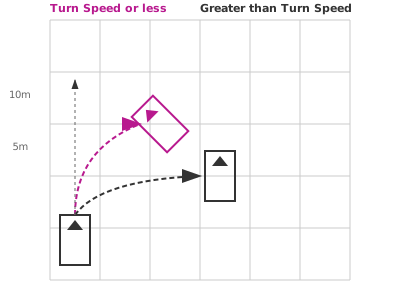
Vehicle Data Table
| Vehicle | Accel (m/turn) | Decel (m/turn) | Top Speed (m/turn) | Turn Speed (m/turn) |
|---|---|---|---|---|
| Ground Car | 60 | 40 | 175 | 80 |
| Ground Transport | 40 | 30 | 125 | 50 |
| Ground Cycle | 100 | 40 | 200 | 100 |
| Hover Car | 80 | 40 | 250 | 70 |
| Hover Transport | 60 | 30 | 250 | 40 |
| Hover Cycle | 100 | 40 | 175 | 90 |
| Explorer | 60 | 40 | 150 | 100 |
Special Maneuvers
Besides driving straight and turning corners, vehicles can perform special maneuvers. These include slips, pivots, skid turns, bumps and stunts.
Slipping. Slipping is similar to "changing lanes"; it allows a vehicle to swerve to the right or left without changing its direction of travel. Any type of vehicle can slip. A slipping vehicle moves 10 meters ahead and 5 meters to either side. This counts as only 10 meters of movement. A vehicle can not turn while slipping. A vehicle can slip once for every 10 meters it moves.
Pivot. A pivot is a turn of up to 360 degrees performed in one spot. Only hover vehicles and Explorers can pivot. A vehicle must be stationary at the beginning of the turn to pivot. The pivoting vehicle stays in the same square, and the driver can rotate it so it points in any direction.
Skid Turns. A skid turn is done by slamming on the brakes while turning so the vehicle skids around 180 degrees. Only ground cars, ground cycles and Explorers can perform skid turns. The vehicle must be traveling from 60 to 80 meters/turn. It actually will move only 20 meters during the turn, and have a speed of 0 at the start of the next turn.
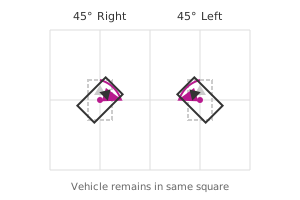
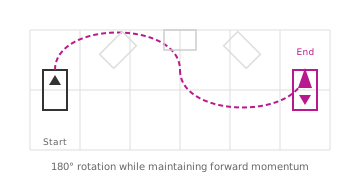
Vehicle Combat
This combat section covers only personal weapons fired from or at vehicles. Vehicle-mounted weapons are not covered in this set of rules.
Firing From Vehicles
A character who fires a weapon from a moving vehicle has a -10 modifier to hit. If the vehicle is moving faster than 150 meters/turn, the modifier is -20.
Shooting At Passengers
A character can shoot at a passenger inside a vehicle. There is a -20 modifier because the passenger has hard cover, and a -10 modifier if the vehicle is moving. Needlers can injure passengers only if the vehicle's windows or top are open.
Firing At Vehicles
If a character fires a weapon at a moving vehicle, he has a -10 modifier to hit. This modifier does not apply if the vehicle is moving directly toward or directly away from the firing character. Needlers and gas grenades have no effect on vehicles.
Damaging Vehicles
Whenever a vehicle is hit by gunfire, an exploding grenade or a thrown explosive, the attacking character must roll 2d10 on the Vehicle Damage Table. The number of dice of damage caused by the attack is added to the result. This number is modified by the type of vehicle. A separate roll is made for each successful attack.
Vehicle Damage Table
| Die Roll + Damage | Effect |
|---|---|
| 2-19 | No Effect |
| 20 | Turn Speed -15 |
| 21 | Acceleration -20 |
| 22 | Top Speed -30 |
| 23 | Steering Jammed Straight |
| 24 | Steering Jammed Left |
| 25 | Steering Jammed Right |
| 26 | Speed -20/Turn |
| 27 | Spin |
| 28 | Vehicle Burning |
| 29 | Roll |
| 30+ | Roll and Burn |
Modifiers: Target is ground or hover cycle +2; Target is Explorer -2
Explanation Of Results
TURN SPEED -15: The vehicle's turn speed is reduced by 15 meters/turn.
ACCELERATION -20/TOP SPEED -30: The vehicle's acceleration or top speed is reduced by the indicated number of meters/turn.
STEERING JAMMED STRAIGHT/LEFT/RIGHT: The vehicle's steering mechanism has been jammed. If straight, the vehicle can not turn. If right or left, the vehicle must turn 45 degrees in the indicated direction after each 20 meters of travel. For example, a skimmer traveling at 80 meters/turn with its controls jammed in a right turn must turn 45 degrees to the right after traveling 20, 40, 60 and 80 meters during its next move. The skimmer can decelerate or accelerate, but can not change its direction.
SPEED -20/TURN: The vehicle must reduce its speed by at least 20 meters/turn until it is stopped. It can decelerate more than this if the driver wants, but it can not accelerate.
SPIN. See Control Table results.
VEHICLE BURNING: The vehicle has caught fire. Each passenger will suffer 1d10 points of damage at the start of every turn they are in the vehicle.
ROLL. See Control Table results.
ROLL AND BURN. See Control Table results.
Bumping
A driver can try to make another vehicle crash by bumping it. In order to bump, one vehicle must stop directly in front of the other vehicle. Both drivers must then make Reaction Speed checks. The driver who performed the bump makes a normal check, but the driver whose vehicle was bumped has a modifier of -15. If either driver fails the check, he loses control of his vehicle (see Crashes).
Stunts
Drivers can perform other stunts, such as jumping their vehicles over bridges, at the referee's discretion. Things to consider when setting up a stunt are the type of vehicle being used, the amount of open space the vehicle has to work with, and the vehicle's condition and cargo.
Short Corners
A driver can try to turn his vehicle tighter than its speed allows, but risks losing control of the vehicle and crashing.
A driver shortens a corner if he tries to turn 5 meters before he should. For example, a ground cycle has a turning speed of 100 meters/turn. If the cycle is traveling 150 meters/turn, it must travel straight for 50 meters before making a turn. If the driver tries to make this second 45 degree turn after traveling straight only 5 meters, he is shortening the corner by 5 meters.
Whenever a driver shortens a corner, the player must roll d100. If the result is less than or equal to the driver's Reaction Speed, the driver makes the turn safely. If the result is higher than the driver's Reaction Speed, the driver loses control during the turn (see Crashes).
Crashes
When a driver loses control of his vehicle, the player must roll d100 and check the Control Table to see what happens to his vehicle. The d100 roll is modified by adding the vehicle's speed in meters/turn to the result.
Control Table
| Die Roll | Result |
|---|---|
| 02-79 | Reduce Speed 20 meters/turn |
| 80-139 | Reduce Speed 50 meters/turn |
| 140-199 | Skid |
| 200-259 | Spin |
| 260-349 | Roll |
| 350-450 | Roll and Burn |
Explanation of Results
REDUCE SPEED: The vehicle immediately reduces its speed by the indicated amount. If this is more than half of the vehicle's current speed, the vehicle slows down to one-half its current speed. The vehicle finishes the move at this new speed.
SKID: The vehicle is skidding out of control. Divide its speed in meters/turn by 10, rounding fractions up. Move the vehicle this number of meters in the direction it was moving before it went out of control. If the vehicle skids into a building or other obstacle, treat it as a collision (see Collisions). Otherwise, the vehicle continues moving from its new position.
SPIN: The vehicle is skidding out of control and spinning. Divide its remaining movement by two. Move it that many meters in the direction it was traveling before it started skidding. Now roll 1d10 and note the number on the die. On the next turn the vehicle will skid to a stop. Move it only half as many meters as it moved on the turn it first went out of control and roll 1d10 again to determine how much it spins.
ROLL: The vehicle is rolling out of control. Treat this the same as a spin, but do not roll 1d10 to determine the vehicle's facing. Instead, each passenger in the vehicle suffers 1d10 points of damage. When the vehicle stops, roll 1d10. If the result is 1, 2 or 3, the vehicle is right-side-up. Otherwise it is on its side or top. The vehicle will run again on 1d10 turns if it was traveling at its turn speed or less.
ROLL AND BURN: Treat this the same as a roll, but the vehicle is burning when it stops. Each passenger suffers an additional 1d10 damage from the fire at the start of each turn he is in the vehicle. A character can get out of the vehicle in one turn if it has stopped rolling. If a character tries to get out of the vehicle while it is rolling, he must make a Reaction Speed check. If he passes the check, he has escaped from the vehicle. If he fails the check, he has not gotten away from the vehicle and he suffers an additional 1d10 damage immediately.
Collisions
If a moving vehicle hits a building, rock, other vehicle or obstacle of any kind, it has collided. The vehicle immediately stops moving.
Damage to Vehicles. If the vehicle was traveling faster than its turn speed, it will not run again without extensive repairs. If the vehicle was traveling at its turn speed or slower, it can be driven again after 1d10 hours. However, its acceleration, deceleration and turn speed are reduced by 20 meters/turn.
Injury to Passengers. When a vehicle crashes, divide its speed in meters/turn by 20, rounding fractions down. The result is the number of d10 that are rolled to determine how many points of damage each character takes. Add 2 points to each die of damage if the character was riding a ground or hover cycle, and subtract 2 from each die if the character was riding in an Explorer. (Use the collision rules as modified below.)
Crash Injuries
| Per 20 meters/turn of vehicle's speed | 1d10 |
| Riding on ground cycle or hover cycle | +2 per d10 |
| Riding in Explorer | -2 per d10 |
ARMOR: Skeinsuits and inertia screens will absorb half of the damage a character suffers in a crash.
Crashing Through Obstacles. If characters try to drive through a barricade or obstacle, the referee must use his discretion to decide how badly the vehicle is damaged, whether it keeps running, and whether the passengers are hurt. A vehicle may be able to smash through obstacles that are less solid than concrete posts or parked vehicles.
Flying Movement
Characters can fly using glijets, jetcopters and aircars. The movement rules for these vehicles are different than those for ground vehicles.
Glijets
A glijet is a combination rocketpack and hang-glider. The rocketpack is used to get the wearer up into the air. The chemical fuel tank holds enough fuel to burn for 20 turns (two minutes). A character can climb 50 meters straight up every turn he burns fuel. The rocket can be turned off at any time. When it is shut off, the wearer can open the collapsible wings and glide. The rocket usually is shut off when gliding, but it can be left on to increase speed.
Speed and Distance. If there is no wind, the wearer can glide 5 meters horizontally for each meter he drops vertically. A gliding character drops 10 meters/turn, with or without using the rocket. If the rocket is used in level flight, the speed increases to 100 kph. Characters can travel much farther and stay aloft much longer if there is wind or if they are riding on rising air currents. This is subject to the referee's discretion, but favorable winds and air currents can multiply the distance traveled and the time spent aloft by as much as 10.
Landing. A character that does not use the rocket to land must pass a Dexterity check in order to land on target. If he fails the check, he misses his target square by 2d10 meters in a random direction.
Tactical Movement. A character that is gliding with the rocket off can make one 45-degree turn per game turn. Using the rocket allows the character to turn up to three times at any point in his move.
Jetcopters and Aircars
Tactical Movement. Jetcopters and aircars can make up to six 45 degree turns in one game turn. These turns can be made at any point in the vehicle's move. Aircars and jetcopters can accelerate or decelerate up to 100 meters/turn each turn. If they are stopped, these vehicles can hover in place and turn to face any direction. They can increase or decrease their altitude by 20 meters/turn.
When scouting, jetcopters and aircars fly at or above the level of the treetops, 50 to 100 meters above the ground. To stay out of sight they can fly very close to the ground, following the contours of the hills and valleys. This is called Nap Of the Earth (NOE) flying. NOE flying limits a jetcopter to its cruising speed and an aircar to 100 kph (175 meters/turn).
Aerial Combat
The following modifiers should be used when flying vehicles are involved in combat.
| Attacker is using glijet or riding in moving jetcopter or aircar | -20 |
| Attacker is riding in jetcopter or aircar that is hovering | -10 |
| Target is using glijet or riding in moving aircar or jetcopter | -10 |
| Target is hovering jetcopter or aircar | 0 |
Other modifiers are used when they apply. Jetcopter passengers can not shoot unless the side doors are open. Aircar passengers can not shoot unless the canopy is open. This exposes the passengers and the pilot to fire, and reduces the aircar's speed to 80 meters/turn.
Damaging Glijets
The only way to shoot down a glijet is to knock out or kill the user. Shooting at the wings has no effect.
Damaging Jetcopters and Aircars
When a shot hits a jetcopter or aircar, the attacker rolls 2d10 and adds the number of dice of damage caused by the attack. This number is found on the Flying Vehicle Damage Table.
Flying Vehicle Damage Table
| Die Roll + Damage | Effect |
|---|---|
| 2-20 | No Effect |
| 21-24 | Acceleration -30 |
| 25-28 | Turns -2 |
| 29-31 | Forced Landing |
| 32-34 | Loss of Control |
| 35+ | Vehicle Burning |
ACCELERATION -30. The vehicle's engines were damaged, reducing its acceleration by 30 meters/turn.
TURNS -2. The vehicle's control and steering equipment was damaged, reducing the number of turns it can make per game turn by two.
FORCED LANDING. The vehicle's fuel tank or parabattery was hit, leaving it with enough fuel to fly for 10 more minutes (100 turns). If the vehicle does not land within 10 minutes, it will crash.
LOSS OF CONTROL. The cockpit was damaged by the attack. The pilot must pass a Reaction Speed check to keep the vehicle under control. If he fails the check, the vehicle immediately loses d100 meters of altitude. If the vehicle loses more altitude than it had, it crashes.
VEHICLE BURNING. The vehicle is out of control and burning. It will crash in two turns. Characters can jump from the vehicle (see Movement: Jumping) or use a parawing. A parawing is a small, emergency glider, similar to a glijet with no rocket. A parawing will not work if the character was less than 10 meters above the ground when he jumped.
Crashing
Passengers in a vehicle that crashes suffer 1d10 points of damage for every 10 meters the vehicle fell, plus 1d10 points of damage for every 20 meters/turn it was traveling. This damage is doubled if the character is not strapped into a seat. When dividing the vehicle's altitude by 10 and speed by 20, round fractions down. If the vehicle is burning, the character suffers an additional 1d10 points of damage at the start of every turn he is in the vehicle. The crashed vehicle will not fly again without extensive repairs.
EXAMPLE: A jetcopter is traveling 75 meters above the ground at 30 meters/turn when an attack damages the cockpit. The pilot fails his Reaction Speed check, so the copter drops d100 meters. The die roll is 83, meaning the vehicle drops 83 meters. This is more than its altitude, so it crashes. One passenger jumps using his parawing, but the pilot does not have one. When the copter hits the ground he suffers 7d10 damage because it fell 75 meters and another 1d10 because it was traveling 30 meters/turn.
Other Vehicles
Many other means of transportation besides those described above are available in STAR FRONTIERS games. The systems and vehicles listed below will not be used in combat very often, but players may find ways to work them into their adventures.
Public Transportation
Monorails are the most common mass transit systems on Frontier worlds. Monorail cars can hold up to six passengers and travel at 70 to 100 meters/turn. Monorail passengers usually pay 1 Cr per day for an unlimited number of rides. Occasionally, monorails are built underground and called subways.
Cabs of many types are common. Ground cars, skimmers and even cycles are used as cabs. Some are operated by drivers while others are piloted by robots or computers. A typical price is 2 Cr for the first km traveled and 1 Cr for each km after that.
Moving Walkways, also called peoplemovers or sliders, are sidewalks that are built like conveyor belts. A person simply steps onto the slider and it carries him, her or it along at 10 meters/turn. Using a slider does not cost anything.
Flyers
Super-Sonic Transports, or SSTs, are large jet-powered aircraft capable of flying at very high altitudes at several times the speed of sound (sound travels 1,988 meters/turn). They are used as luxury passenger planes flying between large cities, as large cargo haulers supplying cities under construction, etc.
Orbital shuttles, often called orbiters, are a cross between an airplane and a space ship. They are powerful enough to fly into orbit around a planet, and sturdy enough to re-enter the atmosphere and land on the surface. They are commonly used to carry supplies and passengers to orbiting space stations and spaceports. An orbiter can reach an orbiting space station in one to two hours.
Water Vehicles
Ships of many varieties are found throughout the Frontier. Players can find anything from three-masted sailing ships to luxury liners and supertankers. Hovercraft are used commonly in areas where the sea is relatively calm. Skimmers can be used over water if the waves are not more than 40 cm high.
Submarines are used on worlds where the seas are very rough, covered with ice or otherwise unsuited to surface travel. They are common around underwater cities and sea bottom mines.
Animals
Riding Animals and beasts of burden are used on many planets where the local technology is not advanced enough to build other ground vehicles, or where their natural abilities to sense water or danger are needed more than a vehicle's speed and reliability.
Type. Common names for rode animals are steeds and mounts.
Temperament. If a creature is naturally aggressive, it may attack strangers or fight back with only a little urging.
Herd. Any creature that fights to protect its family, herd, territory or its young. Creatures that are connected by any instinct other than survival are herding creatures.
Creating Creatures
During an adventure, creatures as well as intelligent alien races may be encountered. Since planets vary so much and so many different worlds to adventure on, it is impractical to give a list of all known creatures. The referee must create the creatures in his adventures.
When creating creatures for STAR FRONTIERS adventures, the referee should give each creature a purpose in the adventure, and should have a reason for placing the creatures where they are on the planet. Referees may find a basic reference book on ecology or biology helpful sources for ideas.
A step-by-step procedure is given below to help the referee create new creatures.
1. What Is the Creature's Purpose?
The referee should decide why the creature is needed in the adventure. Is it to fight the player characters? To mislead them? To be captured or trained? To give them information? To guard them? To set the stage for future encounters? Knowing a creature's purpose will make it easier for the referee to fit the details into place.
When deciding on a purpose for a creature, the referee should consider these other questions:
- Where does the creature live, and where is its lair?
- What lifeform is the creature? (bird, reptile, worm, etc.)
- How does the creature live? Does it have any special habits? (living alone, moving only at night, hanging upside down, shrieking at strangers, etc.)
- Does the creature have any special weaknesses? (poor vision, slow movement, powerful natural enemies, etc.)
2. What Type of Creature Is It?
A creature's type is determined by its size, what it eats and how it obtains its food. Eating habits can divide animals into three basic groups: herbivores (plant eaters), carnivores (meat eaters) and omnivores (plant and meat eaters). After placing the animal in one of these groups, the referee should decide what specific foods it eats and how it gets this food. For example, a creature might eat small rodents that it digs out of the ground with sharp claws.
HERBIVORES are normally timid, but will protect themselves if they are attacked. They usually are adapted to avoid or repel attackers. Some, like bulls, may even counterattack. Herbivores obtain their food by grazing, harvesting, digging, filter-feeding or growing their own.
CARNIVORES may eat any type of meat, but usually prefer only one kind, such as fish or insects. They almost always have effective natural weapons, such as claws, fangs or poisons. These natural weapons make them more dangerous than most herbivores. They may catch their food by hunting, pouncing, or luring prey into traps.
OMNIVORES may or may not be dangerous, but they usually are curious. Many have natural weapons, but these are often less effective than the carnivores' and are used mostly for catching small prey and discouraging predators. Omnivores usually obtain their food by foraging, hunting and scavenging. Most intelligent life forms are omnivores.
Size. A creature's size affects how dangerous the creature is. For example, a large poisonous creature is more dangerous than a small poisonous creature of the same type. There are five different size groups: tiny, small, medium, large and giant.
TINY creatures weigh less than 5 kilograms. They can be up to 25 centimeters long.
SMALL creatures weigh from 5 to 20 kilograms and may be 25 centimeters to 1 meter long.
MEDIUM creatures weigh from 20 to 200 kilograms and are between 2 and 5 meters long.
LARGE creatures weigh from 200 to 1,500 kilograms and are between 2 and 5 meters long.
GIANT creatures weigh more than 1,500 kilograms and are more than 5 meters long.
If the referee wants to create creatures that do not fit into these general categories, such as parasites, waste feeders and energy creatures, he should try to answer the same questions about these creatures that he would for regular creatures.
Examples of Creature Types.
HERBIVORES: rabbits, squirrels, small fish, sloths, sparrows, goats, deer, kangaroos, horses, cattle, camels, tortoises, moths, elephants, hippopotomuses and brontosaurs.
CARNIVORES: frogs, piranhas, shrews, owls, rattlesnakes, wolves, seals, tigers, sharks, crocodiles, tyrannosaurs, squids, spiders and sperm whales.
OMNIVORES: ants, armadillos, porcupines, rats, monkeys, crows, turtles, pigs, chimpanzees, ostriches, bears and whales.
3. How Many of These Creatures are Found Together?
The referee should decide whether the creatures travel alone or in groups. The number in a group depends on the type of creature and the amount of food each needs. Large carnivores usually hunt alone or in small groups, while herbivores tend to travel in herds for protection. The referee can control the effect the creatures have in the adventure by adjusting the number of creatures in a group. A small carnivore is not much of a challenge, but a pack of 100 small carnivores is.
4. How Fast is the Creature?
The referee must decide how fast a creature is and how it moves. Movement is a very important part of combat. Creatures are specially adapted for maximum speed in their native terrain and are not affected by terrain movement modifiers. There are five categories of movement for creatures: very slow, slow, medium, fast and very fast. Player characters fit in the slow category.
| VERY SLOW movement is 15 meters/turn or less. The average very slow speed is 10 meters/turn. |
| SLOW movements 16 to 45 meters/turn. The average slow speed is 30 meters/turn. |
| MEDIUM movement is 16 to 75 meters/turn. The average medium speed is 60 meters/turn. |
| FAST movement is 76 to 105 meters/turn. The average fast speed is 90 meters/turn. |
| VERY FAST movement is more than 105 meters/turn. The average fast speed is 120 meters/turn. |
The referee should decide how the creature moves and whether it has any special way to move. For example, a creature might have wings, fins, a prehensile tail or many legs, allowing it to fly, swim, swing through trees or burrow into the ground. The referee also should note any limits on a creature's movement. For example, some creatures might spend their entire lives in one spot, waiting for their prey to come to them.
5. What Are the Creature's Ability Scores?
The referee must choose the creature's ability scores. Only three of the scores used by characters are needed for creatures: Stamina, Reaction Speed and the initiative modifier. When setting these ability scores, the referee should be sure they fit the purpose of the creature.
A good way to determine the scores is to consider how a similar animal on Earth compares to a Human. Intelligent alien creatures should be treated as non-player characters. The referee should assign scores for all eight of their abilities and for any special abilities.
6. How Does the Creature Attack?
The referee should decide how the creature attacks, what its chance to hit is and how much damage it causes. If the creature has an unusual attack, the referee must decide its effects.
When deciding how a creature attacks, the referee should consider the creature's type and its purpose. In general, carnivores attack to kill, herbivores attack to protect themselves and omnivores attack for both reasons. Carnivores can have claws, teeth, horns and other offensive weapons. Herbivores are more likely to have weapons like quills, repulsive odors or horns.
Most creatures can attack only one target, so the amount of damage a creature causes should be a combination of all its attacks. The referee should consider an animal's size, type and purpose in the adventure when deciding how much damage it causes.
The referee must give the creature a basic chance to hit, called its Attack score. This value should depend on the creature's speed, size and purpose, and also on the abilities of the player characters. A creature's Attack score should never be greater than 100. If the creature can attack several targets at once, this number is used for all attacks.
If the creature has any unusual attacks the referee should record what their effects and limitations are. Unusual attacks include poison, acid, shooting darts and electric shocks. If an attack shoots something, the referee must assign ranges to the attack.
7. How Does the Creature Defend Itself?
The referee should decide whether the creature has any defenses and how they affect combat. Defenses should fit the creature's type and purpose. Defenses are designed to escape or discourage attackers or protect the creature from damage, and are often adapted to the terrain the creature lives in. Some examples are bounding away from attackers, natural camouflage, a thick hide or a protective shell.
8. Does the Creature Have Any Special Abilities?
The referee must decide if the creature has any special abilities or adaptations to the terrain, and their effects in the game. Some examples of special abilities are glowing in the dark, spinning webs, making honey, building crude bridges or homes, changing color or shape, etc. Special adaptations include fur to keep warm in winter, fins to keep cool in the desert, etc. Special abilities make creatures interesting and alien, but referees should not make them too common or players will come to expect them.
9. What Does the Creature Look Like?
The referee should decide what the creature looks like. The answers to the earlier questions will help determine the creature's appearance.
How to Create A New Creature (Summary)
- What is the purpose of the creature in the adventure?
- What type of creature is it?
- How many of these creatures are usually found together?
- How fast is the creature?
- What are the creature's ability scores?
- How does the creature attack?
- How does the creature defend itself?
- Does the creature have any special abilities?
- What does the creature look like?
Creature Reactions
A creature's reaction to a character depends on the creature's temperament and what the character does. The creature may be naturally timid, curious or aggressive; it may be hungry, or it might have just eaten. A character can affect the creature's reaction by ignoring it, coaxing it with food, or frightening it with fire, loud noises or flashes of light. The referee must use his judgement in these cases, but several things to consider are outlined below.
Intelligence. Intelligent creatures will not be frightened by a burning torch, clanging frying pans, etc. Creatures with low intelligence, however, might be easily startled or frightened away by these actions.
Experience. A creature is less likely to be afraid of something it has seen before, unless the previous experience was very painful or frightening.
Size. Large creatures often are harder to frighten than small ones.
Type. Carnivores tend to be more aggressive and harder to frighten than herbivores, which tend to be timid. Omnivores tend to be curious.
Temperament. If a creature is naturally aggressive, it may attack creatures much larger than itself with very little fear. Timid creatures try to avoid fighting whenever they can.
Motivation. Any creature that fights has a reason for fighting. Even naturally shy and weak creatures may fight savagely to defend their lair, their territory or their young. Creatures that are cornered or wounded, sensing that they must fight or die, often fight ferociously and without fear.
Creature Descriptions
After a referee designs a creature, he should write the information about it in a standard format. The information should be listed in the following order:
- TYPE: the creature's size and eating habits
- NUMBER: the number of creatures usually found together
- MOVE: the creature's movement category. The referee can include the actual rate per turn. If the creature can be ridden, its rate per hour should also be included.
- IM/RS: the creature's Initiative Modifier and Reaction Speed
- STAMINA: the creature's Stamina points
- ATTACK: the creature's basic chance to hit
- DAMAGE: the number of dice that are rolled to determine damage when the creature attacks
- SPECIAL ATTACK: a brief note on the effects of special attacks and ranged attacks. More detail is given in the description.
- SPECIAL DEFENSE: brief note on special defenses. More detail is given in the description.
- NATIVE WORLD: the planet where the creature is found and the terrain it normally inhabits
- DESCRIPTION: a brief description of the creature and notes on habits, includes how the creature moves, an explanation of its attacks, and any special abilities or defenses
Average Creatures
Average values and ranges for each of the standard creature types are listed below. When a range is listed, the referee should choose a number in that range. The referee can use these tables when he needs a new creature quickly. The scores can be used as they are listed, or modified to produce creatures with above or below average statistics. Special Attacks, Defenses and Abilities are not listed. These are left to the imagination of the referee.
Herbivores
| Tiny | Small | Medium | Large | Giant | |
|---|---|---|---|---|---|
| NUMBER | 1-100 | 1-20 | 10-100 | 1-20 | 1-10 |
| MOVE | Medium | Fast | Very Fast | Fast | Slow |
| IM/RS | 8/75 | 7/65 | 6/55 | 5/45 | 4/35 |
| STAMINA | 1-10 | 5-20 | 20-100 | 50-150 | 100-300 |
| ATTACK | 30 | 35 | 40 | 45 | 50 |
| DAMAGE | 1d2 | 1d5 | 1-2d10 | 1-3d10 | 2-6d10 |
Carnivores
| Tiny | Small | Medium | Large | Giant | |
|---|---|---|---|---|---|
| NUMBER | 1-50 | 1-20 | 1-10 | 1-5 | 1-2 |
| MOVE | Fast | Fast | Medium | Medium | Medium |
| IM/RS | 7/65 | 6/60 | 6/55 | 5/50 | 5/45 |
| STAMINA | 1-10 | 10-20 | 20-120 | 75-200 | 100-400 |
| ATTACK | 55 | 65 | 75 | 65 | 55 |
| DAMAGE | 1d5 | 1d10 | 1-3d10 | 2-5d10 | 3-10d10 |
Omnivores
| Tiny | Small | Medium | Large | Giant | |
|---|---|---|---|---|---|
| NUMBER | 1-20 | 1-10 | 1-5 | 1-5 | 1-3 |
| MOVE | Medium | Medium | Slow | Slow | Slow |
| IM/RS | 7/70 | 6/60 | 5/50 | 5/45 | 4/40 |
| STAMINA | 1-10 | 5-20 | 20-100 | 50-150 | 150-300 |
| ATTACK | 45 | 50 | 55 | 60 | 65 |
| DAMAGE | 1d5 | 1d10 | 1-2d10 | 1-5d10 | 2-8d10 |
Sample Creatures
All of the following creatures are found on the planet Volturnus, the setting for the module enclosed with the game.
Strangler Chutes
- TYPE
- Large Herbivore
- NUMBER
- 5-20
- MOVE
- Slow (10 meters/turn on ground) or Windspeed (in air)
- IM/RS
- 3/25
- STAMINA
- 150
- ATTACK
- None
- DAMAGE
- 3 points/turn
- SPECIAL ATTACK
- Accidental attack (See below)
- SPECIAL DEFENSE
- Electrical shock stuns for 1d10 turns if touched
- NATIVE WORLD
- Volturnus - wooded areas
DESCRIPTION: Strangler chutes look like giant jellyfish floating in the air. They are 10 meters wide, but weigh only 50 kilograms. They move by rising on warm air and drifting through the skies. They communicate with each other by changing colors, and see with many eyespots located along the edge of their canopy.
Strangler chutes eat the leaves of trees by draping their bodies across the branches and releasing digestive fluids. Animals caught inside the chute automatically take three points of damage each turn. If a character is in or underneath a tree when a strangler chute lands on it, he must make a Reaction Speed check to escape. The body and tentacles of a strangler chute are electrified and any character that touches one must pass a Reaction Speed check or be stunned for 1d10 turns. If characters use ranged weapons to attack a chute that has entangled a companion, there is a 20% chance that any hit on the chute will cause equal damage to the trapped character.
Army Rats
- TYPE
- Small Carnivore
- NUMBER
- 2-20 per character, 1,000 or more in a pack
- MOVE
- Fast (90 meters/turn)
- IM/RS
- 6/60
- STAMINA
- 5
- ATTACK
- 40
- DAMAGE
- 1d5 bite + disease
- SPECIAL ATTACK
- None
- SPECIAL DEFENSE
- None
- NATIVE WORLD
- Volturnus - mountains
DESCRIPTION: Army rats are furry brown creatures that resemble large rats. They have powerful hind legs and can leap up to 1 meter to attack. Army rats swarm in packs of 1,000 or more, and will attack any animal in their path. They are cunning and attack in waves, some sprinting after prey while others follow at a loping stride. When one wave of sprinters falters, another wave takes their place until the prey finally tires. A medium-sized creature caught by a swarm will be attacked by 2-20 army rats, while the rest pass by seeking other food.
Any creature bitten by an army rat has a 50% chance of being infected by a disease that attacks the central nervous system. A creature only needs to roll once per encounter with army rats. Unless a victim is given a dose of Antibody Plus within 12 hours, he will become hostile and paranoid and might even attack or desert his companions. Every 20 hours after being bitten the victim can make a Stamina check. If the character succeeds, he has recovered. If not, another 20 hours must pass before the victim can try again.
Funnel Worm
- TYPE
- Giant Carnivore
- NUMBER
- 1
- MOVE
- Slow
- IM/RS
- 4/35
- STAMINA
- 200
- ATTACK
- 45 (on surface)
- DAMAGE
- 3d10 bite
- SPECIAL ATTACK
- Automatic hit if prey falls in funnel
- SPECIAL DEFENSE
- Will not be noticed unless it attacks
- NATIVE WORLD
- Volturnus - desert
DESCRIPTION: The funnel worm is a burrowing creature 5 to 7 meters long, with a segmented body and two large compound eyes which are also pressure-sensing organs. It has a pair of large mandibles and its mouth is filled with a ring of sharp teeth.
Funnel worms are solitary creatures. They lurk 5 to 10 meters beneath the surface waiting for prey to pass overhead. When it senses the vibrations of a creature passing, it quickly expands its body, swallowing the sand and forming a 10-meter-wide funnel of sand. The prey slides down the funnel into the worm's mouth. Any creature caught in the funnel must make a Reaction Speed check to leap aside. If the check is failed the creature will slide down the funnel and into the funnel worm's mouth in 2 turns. The funnel worm can automatically bite anything that falls into its mouth, causing 3d10 points of damage per turn to each victim until it dies. A funnel worm's mouth is wide enough to hold and bite up to three medium-sized creatures at once. Characters can be rescued if someone throws them a rope and pulls them out.
While in its burrow, a funnel worm can not be attacked by most weapons. Grenades and explosives are the most effective means of attack. They hit automatically when rolled down the funnel, but cause only half damage. The funnel worm will burrow to the surface and attack if it is wounded. A funnel worm's Attack score is 45 when out of its burrow.
Megasaurus
- TYPE
- Giant Carnivore
- NUMBER
- 1
- MOVE
- Fast (90 meters/turn)
- IM/RS
- 5/45
- STAMINA
- 350
- ATTACK
- 50
- DAMAGE
- 7d10 bite and claws
- SPECIAL ATTACK
- None
- SPECIAL DEFENSE
- None
- NATIVE WORLD
- Volturnus - dry plains, swamp
DESCRIPTION: A megasaurus is 10 meters long and stands 5 meters high at the shoulders. It looks like a giant reptilian cat with a thick tail. It has huge claws and a massive mouth filled with sharp teeth, and can leap up to 50 meters to attack.
Land Whale
- TYPE
- Giant Omnivore
- NUMBER
- 1
- MOVE
- Medium
- IM/RS
- 3/25
- STAMINA
- 300
- ATTACK
- 65
- DAMAGE
- 1d10 bite
- SPECIAL ATTACK
- A successful bite will swallow prey; a swallowed victim can not attack
- SPECIAL DEFENSE
- None
- NATIVE WORLD
- Volturnus - dry plains
DESCRIPTION: A land whale looks like a 10-meter-long whale with eight short legs. Its jaws are hinged sideways. A land whale will swallow anything in its path, moving until its large mouth is full before stopping to digest the food. Land whales travel alone. They can move swiftly, but start slowly. They can start moving at a speed of 10 meters/turn, and can accelerate 10 meters/turn until they reach their top speed of 60 meters/turn.
A character bitten by a land whale must roll his Reaction Speed or less to avoid being swallowed. A swallowed character will automatically take 1d10 points of damage each turn until cut out of the land whale.
Slither (Sathar Attack Monster)
- TYPE
- Giant Carnivore
- NUMBER
- 1
- MOVE
- Slow (10 meters/turn)
- IM/RS
- 5/45
- STAMINA
- 400
- ATTACK
- 30
- DAMAGE
- 6d10 tentacles and bite
- SPECIAL ATTACK
- Camouflage may surprise victims
Can attack two creatures at once - SPECIAL DEFENSE
- None
- NATIVE WORLD
- None - salt flats and near water
DESCRIPTION: A slither is 20 meters long and 2 meters wide. It resembles a giant-sized cross between a worm and a centipede. It is part plant and part animal; plants grow from its back, providing camouflage and some nourishment from photosynthesis. It can only see moving objects, but can sense salt and water. One often lurks near pools of water or salt licks, waiting for prey.
When lying still, a Slither is often mistaken for a mound of plants, allowing it to attack with surprise. Its gnashing, grinding mandibles are surrounded by 2-meter-long tentacles. Slithers also secrete an oily fluid that causes burns on touch. They attack by lashing out with their tentacles, by biting with their jaws and by coiling around prey and burning it with their secretions. They must re-coil and make a new attack roll each turn to coil about prey. A slither can attack two creatures on the same turn, one with its tentacles and bite and the other by coiling around it. This makes them very deadly in combat.
Slithers are Sathar attack monsters. The Sathar, in their efforts to destroy peaceful worlds, have genetically altered a number of creatures into "monsters" which they set free on various worlds. Slithers and other Sathar attack monsters can be encountered on many different planets.
Sand Shark
- TYPE
- Large Carnivore
- NUMBER
- 1-2
- MOVE
- Medium
- IM/RS
- 5/50
- STAMINA
- 80
- ATTACK
- 50
- DAMAGE
- 2d10 bite
- SPECIAL ATTACK
- None
- SPECIAL DEFENSE
- Immune to needler weapons; has hard cover when attacking from burrow
- NATIVE WORLD
- Volturnus - deserts
DESCRIPTION: The sand shark is a burrowing creature. It is 3 meters long, has a wedge-shaped head, thick, abrasive, leathery hide and twelve pairs of short legs. A sand shark has no eyes; it detects things by vibration, and smells through two rows of sensory organs and two sensory pits in the head. A sand shark burrows just beneath the surface of the sand, leaving a telltale ripple in its wake. Only explosives will affect it when it is beneath the sand, and they cause only half-damage. It reveals itself when it erupts at the feet of its target to attack. It attacks by biting. Its large mouth is filled with three rows of jagged teeth.
The sand shark can cross rocky areas by slithering across the surface, but its movement rate is reduced to Slow.
Winged Rippers
- TYPE
- Small Carnivore (Scavenger)
- NUMBER
- 4-40
- MOVE
- Fast
- IM/RS
- 6/55
- STAMINA
- 30
- ATTACK
- 60
- DAMAGE
- 1d5 beak
- SPECIAL ATTACK
- None
- SPECIAL DEFENSE
- None
- NATIVE WORLD
- Volturnus - all terrains
DESCRIPTION: Winged rippers are scavenger birds that gather in great numbers around any carrion. A ripper looks like a cross between a vulture and a hummingbird. Their brownish-gray feathers look tattered, and have a distinct odor of decay.
Winged rippers are impatient and may attack small animals or sick or injured creatures. A large number of winged rippers (more than 20) may attack healthy creatures of man-size or larger. When they attack, the entire flock swoops at the intended victim. As they pass, 1d10 of the creatures will slash with their razor-sharp beaks. Winged rippers are basically cowardly, however, and if more than one-tenth of the flock is killed, all the rest will flee.
Queequeg
- TYPE
- Large Carnivore
- NUMBER
- 1-5
- MOVE
- Fast (90 meters/turn)
- IM/RS
- 6/60
- STAMINA
- 180
- ATTACK
- 50
- DAMAGE
- 3d10 harpoon
- SPECIAL ATTACK
- Harpoon can strike victim up to 5 meters away
- SPECIAL DEFENSE
- Chitinous exoskeleton acts as skeinsuit, reducing damage from non-energy attacks by half
- NATIVE WORLD
- Volturnus - forest
DESCRIPTION: Queequegs have barrel-shaped bodies with three jointed legs arranged like a tripod, and three eyes spaced evenly around the body so it can see all directions at once. They have a hard exoskeleton that matches the color of the plants where they live, providing a natural camouflage. Its mouth is in its underbelly, surrounded by small tentacles. A single 5-meter-long tentacle grows from the top of the body. The long tentacle tapers to a point with a razor-sharp barb.
The queequeg attacks by whipping this tentacle at its prey like a harpoon. Once the tentacle hits a target the sharp barb makes it difficult to pull out. The queequeg then pulls the victim to its mouth in one turn, and holds the prey with the filaments while devouring it. A character that is being eaten automatically takes 2d10 points of damage each turn until rescued. The victim can not fight back once he is held in the small tentacles. If characters attack the harpoon tentacle and cause 20 points of damage, the tentacle is severed.
Tomar's Horses
- TYPE
- Large Omnivore
- NUMBER
- 1-100
- MOVE
- Fast (90 meters/turn, 25 km/hour)
- IM/RS
- 6/60
- STAMINA
- 120
- ATTACK
- 40
- DAMAGE
- 3d10 bite and hooves
- SPECIAL ATTACK
- Stampede Attack score 70, 8d10 damage
- SPECIAL DEFENSE
- None
- NATIVE WORLD
- Volturnus - dry plains
DESCRIPTION: Tomar's horses look like a cross between a horse and a jackal. They stand 1.6 meters tall at the shoulder and weigh about 400 kilograms. Tomar's horses eat seeds, nuts, grains, berries and meat. They will eat carrion, but prefer fresh meat.
Tomar's horses are cunning. They may stalk their prey, taking advantage of cover to hide their approach. They try to herd their prey into traps so it can not escape. Individual Tomar's horses attack by pawing with their hooked hooves and biting.
A herd of Tomar's horses can attack by stampeding and trampling its prey. When a hungry herd sights prey it will charge the creatures and attempt to trample them. Their Attack score for a stampede attack is 70. Characters are safe from a stampede if they find hard cover to hide behind. If no cover is available, the character can try to stun or kill one of the lead animals and hide behind its body. There is a 75% chance the herd will charge again if the prey survived the first stampede. If more than one horse was killed in a stampede, there is only a 25% chance they will attack again. A trampled character takes 8d10 points of damage.
Equipment
This section lists the equipment available on most Frontier worlds and describes how each item works.
Equipment Lists
Beam Weapons
| Weapon | Cost (Cr) | Mass (kg) |
|---|---|---|
| Electrostunner | 500 | 1 |
| Laser Pistol | 600 | 1 |
| Laser Rifle | 800 | 3 |
| Sonic Disruptor | 700 | 4 |
| Sonic Stunner | 500 | 1 |
| Heavy Laser | 6,000 | 20 |
| Sonic Devastator | 5,000 | 15 |
Projectile Weapons
| Weapon | Cost (Cr) | Mass (kg) |
|---|---|---|
| Automatic Pistol | 200 | 2 |
| Automatic Rifle | 300 | 4 |
| Needler Pistol | 200 | 1 |
| Needler Rifle | 400 | 3 |
| Machine Gun | 2,000 | 20 |
| Recoilless Rifle | 4,000 | 20 |
Gyrojet Weapons
| Weapon | Cost (Cr) | Mass (kg) |
|---|---|---|
| Gyrojet Pistol | 200 | 1 |
| Gyrojet Rifle | 300 | 4 |
| Grenade Rifle | 700 | 4 |
| Grenade Mortar | 2,000 | 15 |
| Rocket Launcher | 5,000 | 15 |
Grenades
| Type | Cost (Cr) |
|---|---|
| Doze Grenade | 10 |
| Fragmentation Grenade | 20 |
| Incendiary Grenade | 20 |
| Poison Grenade | 30 |
| Smoke Grenade | 10 |
| Tangler Grenade | 25 |
Melee Weapons
| Weapon | Cost (Cr) | Mass (kg) |
|---|---|---|
| Brass Knuckles | 10 | 1 |
| Electric Sword | 150 | 2 |
| Nightstick | 20 | 1 |
| Polearm | 40 | 4 |
| Shock Gloves | 50 | 1 |
| Sonic Knife | 50 | 1 |
| Sonic Sword | 300 | 1 |
| Stunstick | 75 | 1 |
| Sword | 30 | 2 |
| Vibroknife | 25 | 1 |
| Whip | 20 | 1 |
Archaic Weapons
| Weapon | Cost (Cr) | Mass (kg) |
|---|---|---|
| Axe | 15 | 1 |
| Bow | 50 | — |
| Knife | 10 | — |
| Musket | 100 | 2 |
| Spear | 20 | 1 |
Defenses
| Type of Defense | Cost (Cr) | Mass (kg) | Energy | Def. Against |
|---|---|---|---|---|
| Power Screens | ||||
| Albedo Screen | 2,000 | 2 | 1 SEU/min | lasers |
| Gauss Screen | 1,000 | 2 | 2 SEU/Hit | electric stun |
| Holo Screen | 1,000 | 2 | 1 SEU/min | — |
| Inertia Screen | 2,000 | 3 | 2 SEU/hit | ballistic melee |
| Sonic Screen | 2,000 | 2 | 1 SEU/min 2 SEU/hit | sonic |
| Defense Suits | ||||
| Albedo Suit | 500 | 1 | 100 points | laser |
| Military Skeinsuit | 300 | 1 | 50 points | ballistic/melee |
| Civilian Skeinsuit | 500 | 1 | 50 points | ballistic/melee |
Ammunition
| Type of Ammunition | Cost (Cr) | Mass (kg) | Energy/Rounds |
|---|---|---|---|
| Beam Weapon Ammunition | |||
| Powerclip | 100 | — | 20 SEU |
| Power Beltpack | 250 | 4 | 50 SEU |
| Power Backpack | 500 | 10 | 100 SEU |
| Gyrojet Ammunition | |||
| Pistol Jetclip | 10 | — | 10 rounds |
| Rifle Jetclip | 20 | — | 10 rounds |
| Grenade Bullet | 3 | — | 1 round |
| Grenade Shell | 8 | — | 1 round |
| Rocket | 15 | 4 | 1 round |
| Projectile Weapon Ammunition | |||
| Pistol Bulletclip | 2 | — | 20 rounds |
| Rifle Bulletclip | 5 | — | 20 rounds |
| Pistol Needleclip | 10 | — | 10 rounds |
| Rifle Needleclip | 20 | — | 10 rounds |
| Machine Gun Belt | 50 | 4 | 200 rounds |
| Recoilless Shell | 10 | 1 | 1 round |
| Archaic Weapon Ammunition | |||
| Arrow | 2 | - | 20 arrows |
| Powder and Shot | 10 | 1 | 20 rounds |
Toolkits
| Toolkit or Refill | Cost (Cr) | Mass (kg) |
|---|---|---|
| Techkit | 500 | 12 |
| Robcomkit | 500 | 10 |
| Medkit | 500 | 10 |
| Antibody Plus | 5 | — |
| Antitox | 5 | — |
| Biocort | 10 | — |
| Omnimycin | 5 | — |
| Staydose | 5 | — |
| Stimdose | 5 | — |
| Telol | 10 | — |
| Envirokit | 500 | 10 |
Weapon Descriptions
Beam Weapons
Electrostunner. An electrostunner looks like a large pistol. It is a short-range weapon. It fires an arc of electrons that looks like a lightning flash. It is commonly called a zapgun because of the noise it makes when fired. An electrostunner has two settings, stun and blast. A blast causes 4d10 points of damage. A stun can knock a creature unconscious for d100 turns. Anyone hit by a stun beam can resist the stun by rolling a number less than or equal to its current Stamina. A zapgun uses two SEU per shot. It holds a 20 SEU clip, but can also be connected to a beltpack or powerpack with a 1.5 meter powercord. A gauss screen will block the electrostunner's beam. An anti-shock implant will nullify a stun but not a blast.
Laser Pistol. A laser pistol is a large handgun. It fires a pulse of bright light. Laser pistols are commonly called blasters. A laser pistol has a dial that can be set from 1 to 10 to control how many SEU are fired by each shot. Each SEU fired causes 1d10 points of damage. For example, when the dial is set at 3, the shot uses 3 SEU and causes 3d10 points of damage. Players must tell the referee what setting they are using before rolling the dice to see if the shot hits. Laser pistols use 20 SEU clips but can be attached to beltpacks or powerpacks. An albedo suit or screen halves the damage from lasers.
Laser Rifle. A laser rifle is a rifle-sized version of a laser pistol. It has a longer range and the SEU dial can be set from 1 to 20 instead of 1 to 10.
Sonic Disruptor. A sonic disruptor is a type of rifle. It is commonly called a disruptor. A sonic disruptor generates a focused sound beam. The damage it causes depends on the range. At closer ranges, it causes more damage. It causes 6d10 at point blank range, 4d10 at short range, 2d10 at medium range, and 1d10 at long range. It has no extreme range. It uses a 20 SEU clip but can also be attached to a beltpack or powerpack. A disruptor uses 4 SEU per shot. Only a sonic screen can stop its deadly beam.
Sonic Stunner. A sonic stunner is a type of pistol. It is commonly called a stunner. It will stun a victim for d100 turns. The victim can avoid the effect of the hit by rolling his current Stamina or lower. One shot uses two SEU. It uses a 20 SEU clip, but can be attached to a beltpack or a powerpack. A target with an anti-shock implant can not be stunned. Otherwise, only a sonic screen can stop the stunner's sound beam.
Heavy Laser. A heavy laser is about the size of a machine gun. It must be mounted on a tripod or a swivel mount to be fired. It has longer range than a laser rifle, and a minimum SEU setting of 5. Otherwise it operates the same as the laser rifle.
Sonic Devastator. A sonic devastator is a heavy weapon that must be mounted on a tripod or a swivel mount to be fired. Except for its greater range and damage, the sonic devastator operates just like the sonic disruptor.
Projectile Weapons
Automatic Pistol. An automatic pistol is a refined version of the submachine gun. It looks like a heavy pistol, with a folding metal wire stock. The gun can be fired like a pistol when the stock is folded, or fired from the shoulder when the stock is extended. An automatic pistol can be set to fire single shots or bursts. Up to three single shots or one burst can be fired in a turn. A single shot causes 1d10 points of damage. A burst fires 10 bullets, and has a +20 modifier to hit. It can be aimed at up to five adjacent targets in a 10-meter wide area. A burst causes 5d10 points of damage, plus 1d10 for every additional target after the first. Only one roll is needed to hit all the targets, but any negative modifiers that could apply to one target apply to the entire group. For example, if one target has soft cover, all of them are considered to have soft cover. The damage from a burst is divided as evenly as possible between all the targets. Skeinsuits and inertia screens reduce bullet damage by half. If a skeinsuit and an inertia screen are used together, damage is reduced to one-fourth the amount rolled.
Automatic Rifle. An automatic rifle is similar to the automatic rifles being used today. It is basically a heavier, longer version of the automatic pistol. It can fire up to three single shots or one burst.
Needler Pistol. A needler pistol is a handgun that uses an upright disc clip. It makes only a very soft, coughing noise when it is fired. Needler pistols magnetically propel a cluster of needles at high speed. Two types of needles can be used: barbed needles that cause 2d10 points of damage per shot, and anesthetic needles that cause only 1d10 points of damage but can put the victim to sleep for d100 turns. An individual can resist the anesthetic by passing a current Stamina check. Needles will not penetrate skeinsuits or inertia screens. Neither the suit, screen, or individual is damaged.
Needler Rifle. A needler rifle is a rifle-sized version of a needler pistol. It has a longer range than a needler pistol and its barbed ammunition does more damage (the longer barrel gives the needles more velocity).
Machine Gun. A machine gun is a fully automatic heavy weapon that must be mounted on a tripod or a swivel mount to fire. A burst fires 20 bullets. Except for its greater damage and range, it operates just like an automatic pistol.
Recoilless Rifle. A recoilless rifle is a heavy weapon that must be mounted on a tripod or a swivel mount to fire. It fires an exploding shell that causes 12d10 points of damage if it hits. Only one shell can be fired per turn, and loading another shell takes one turn. Inertia screens and skeinsuits halve the damage.
Gyrojet Weapons
Gyrojet Pistol. A gyrojet pistol is a large handgun. It shoots miniature, self-propelled rockets that cause 2d10 points of damage when they explode. A gyrojet pistol is not effective at very short range, because the rocket is still accelerating. Thus the short range modifier is used even at point blank range. Skeinsuits and inertia screens absorb half the damage from a gyrojet rocket.
Gyrojet Rifle. A gyrojet rifle is the rifle-sized version of a gyrojet pistol. It has a longer range and causes 3d10 points of damage per shot.
Grenade Rifle. A grenade rifle resembles a shotgun. It fires hand grenades that are fitted into special grenade bullets. Any type of grenade can be used. It can fire one shot per turn, and then must be reloaded, which also takes one turn. If a shot misses, the grenade does not scatter. Depending on what type of grenade is being used, all the usual grenade saving throws apply.
Grenade Mortar. A grenade mortar is a hollow tube that is attached at an angle to a large base plate. It can fire any type of grenade, using a special shell called a grenade shell. It operates like a grenade rifle, except for the greater range. Because it lobs grenades in a high arc, it has a minimum range of 10 meters.
Rocket Launcher. A rocket launcher is a long, hollow tube that is fired while resting across the firer's shoulder. It fires a large, long-range rocket. It must be reloaded after every shot, and reloading takes one turn.
Grenades
Grenades can be thrown or fired from a grenade rifle or mortar. Characters can avoid or resist the effect of a grenade by passing an ability check that applies to the grenade. Grenades can be set to explode in two ways: on impact or with a timer that is adjustable for 1 to 10 turns. All grenades have a blast radius of 3 meters. Any character or creature within 3 m of a grenade when it goes off can be affected.
Doze Grenades. A doze grenade releases a cloud of fast-acting knockout gas. All creatures within the blast radius will fall asleep for d100 turns unless they pass a current Stamina check. A shot of stimdose will revive a sleeping individual immediately. The doze gas is effective only on the turn that the grenade goes off.
Fragmentation Grenade. Fragmentation grenades are commonly called frag grenades. Any creature or character in the blast radius suffers 8d10 points of damage. This damage is cut in half if the individual passes a Reaction Speed check. Inertia screens and skeinsuits also reduce damage by half. All of these modifiers are cumulative.
Incendiary Grenade. An exploding incendiary grenade scatters sticky, flaming liquid across everything in the blast radius. Incendiary grenades are commonly called fire grenades. A fire grenade causes 4d10 points of damage on the turn it explodes. The burning liquid sticks to the victim, causing an additional 1d10 points of damage on the second, third and fourth turns after the explosion. A character that passes a Reaction Speed check takes only half damage. Anyone in a spacesuit takes no damage from an incendiary grenade.
Poison Grenade. A poison grenade releases a cloud of poisonous gas. Anyone in the blast radius will be poisoned by the gas. The gas is effective only on the turn the grenade explodes. The gas acts as an S5/T10 poison. A character who passes a current Stamina check will not be affected, nor will anyone in a gas mask. A shot of antitox will neutralize the poison so that no further damage is taken.
Smoke Grenade. A smoke grenade produces a thick cloud of smoke that both blocks vision and acts like tear gas. Smoke grenades are available in colors so they can be used as signals. Anyone in the blast radius on the turn the grenade explodes must make a current Stamina check. If the character fails the check he has a -10 modifier on all ability checks for 1d10 turns, due to coughing and blurred vision. The smoke will continue to spread 3 meters/turn for five turns, when it will cover an area 30 meters in diameter. The smoke cloud gives soft cover to anyone behind it or inside it. The smoke screen will last for 10 minutes.
Tangler Grenade. An exploding tangler grenade throws out hundreds of strong, sticky polymer threads. These threads stick to everything within the blast radius. An entangled individual can not move until the threads decay (in 30 minutes) or until solvaway is spread over the threads. Any creature with more than 100 stamina points can break out of tangler threads in one turn.
Archaic Weapons
Bow. For simplicity, all bows (crossbows, longbows, composite bows, etc.) are handled the same. An arrow causes 1d10 points of damage. Readying another arrow takes one full turn. Inertia screens and skeinsuits halve the damage from an arrow.
Musket. Muskets include all muzzle-loading firearms, such as arquebuses, blunderbusses, and flintlock rifles. Muskets use black gunpowder and lead bullets (powder and shot). Loading a musket takes two turns, so a musket can be fired only once every three turns.
Melee Weapons
Axe. An axe is actually a tool, but it can be used as either a thrown or melee weapon. If used as a thrown weapon, all the usual ranged weapon modifiers apply. Inertia screens and skeinsuits will halve the damage from an axe.
Brass Knuckles. Besides actual brass knuckles, this category includes any improvised weapon that increases the damage caused by someone's fist. Examples are rocks, coin rolls, sword or dagger handles, etc. Inertia screens and skeinsuits halve the damage from brass knuckles.
Chain/Whip. Besides chains and whips, this category includes any flexible weapon, such as flails, nunchuks, weighted ropes, etc. Inertia screens and skeinsuits absorb half the damage caused by these types of weapons.
Club. Any blunt weapon used like a club is considered a club. This includes chair legs, metal pipes and bottles. Inertia screens and skeinsuits reduce club damage by half.
Electric Sword. This is a light-weight metal rod that contains a battery in the handle. It delivers an electrical shock when it strikes someone. It can be set to shock or stun. When set on stun, a successful hit causes no damage but can stun the victim for d100 turns. The victim can resist the stun by making a successful current Stamina check. An electric sword can be hooked into a beltpack or powerpack with a power cable. A successful hit by an electric sword uses 2 SEU. Individuals wearing gauss screens or with anti-shock implants are not affected by electric swords.
Knife. This category covers any knife that is big enough to fight with. If thrown, the usual ranged combat modifiers apply. Inertia screens and skeinsuits will absorb half of the damage caused by a knife.
Nightstick. A nightstick is a weighted plastic club. This category also includes improvised weapons that are more effective than simple clubs, like chairs, baseball bats and quarterstaffs. Inertia screens and skeinsuits halve the damage from a nightstick.
Polearm. A polearm consists of a long pole with a heavy blade at one end. Typical polearms are halberds, partisans, naginatas and glaives. Inertia screens and skeinsuits halve the damage from a polearm.
Shock Gloves. Shock gloves are silvery gloves that deliver an electrical shock to anything they touch. They must be connected to a beltpack or powerpack to work. Shock gloves will not affect anyone protected by a gauss screen or an anti-shock implant. Shock gloves use 2 SEU each time they hit.
Sonic Knife. A sonic knife looks like a golden tube, 15 cm long and 4 cm in diameter. This tube is actually only the weapon's handle. When a small button on the side of the tube is pressed, a powerful "blade" of focused sound is created at one end of the tube. The sound blade is about 20 cm long, and is invisible. It emits a high-pitched whine, however. The blade is turned off when the button is released. The knife is powered by a 20 SEU clip, but can be hooked into a beltpack or power pack. A sonic knife uses 1 SEU when it hits. Anyone wearing a sonic screen can not be injured by a sonic knife. Unlike a regular knife, a sonic knife cannot be thrown.
Sonic Sword. A sonic sword looks like a sonic knife, but the blade is 1 m long when it is turned on. A sonic sword causes 5d10 damage and uses 2 SEU when it hits.
Spear. Any pole with a knife-like blade on the end is a spear. Bayonets and pikes are included in this category. Inertia screens and skeinsuits halve the damage from a spear.
Stunstick. A stunstick is a copper-colored tube 30 cm long and 3 cm in diameter, with an insulated grip. It has two settings: shock and stun. When set on shock, a successful hit causes 3d10 points of damage. When set on stun, a successful hit will stun the victim for d100 turns. A character can resist the stun by making a successful check against his current Stamina. A successful hit uses 2 SEU. A 20 SEU clip can be fitted into the handle, or the weapon can be connected to a beltpack or powerpack. A character with an anti-shock implant is immune to the stun setting.
Sword. Any long-bladed, hand-held weapon is a sword. Examples are broadswords, machetes or rapiers. Inertia screens and skeinsuits reduce the damage from a sword by half.
Vibroknife. A vibroknife has a 20 cm saw-toothed blade. When it is turned on, the blade vibrates at high speed. It uses 1 SEU with each successful hit. A 20 SEU clip can be plugged into the handle, or the weapon can be connected to beltpack or powerpack. Inertia screens and skeinsuits halve vibroknife damage.
Ammunition
Beam Weapon Ammunition
Powerclip. The standard 20 SEU powerclip is a sturdy plastic box about the size of a cigarette pack. A powerclip will fit any weapon that can use a powerclip. Players must keep track of how many SEU are in the clip. Powerclips can not be recharged.
Power Beltpack. A power beltpack is a 20 cm x 8 cm x 5 cm plastic box that attaches to a character's belt. It comes with three different powercords that can be plugged into three distinct outlets in the side of the unit. One port is for weapons, one is for screens and one is for auxiliary equipment such as scanners or radios. Only one weapon and one screen can be plugged into a beltpack at the same time. Beltpacks can be recharged at a cost of 5 credits per 1 SEU recharged. Recharging can be done at any weapons shop, hardware store or fuel station.
Power Backpack. A power backpack is worn on a harness that slips over the shoulders. Special adapters are available for Dralasites at no additional cost. A backpack has two weapon ports, one screen port and three auxiliary ports. Only two weapons can be connected to the same backpack. Backpacks can be recharged for 5 credits per 1 SEU recharged. It takes two turns to plug in or unplug a powercord from a power backpack.
Projectile Ammunition
Bulletclip. A bulletclip is a plastic, spring-loaded rack of bullets, 5 cm x 2.5 cm x 15 cm. It holds 20 bullets for either an automatic pistol or rifle. Rifle and pistol clips are not interchangeable.
Needleclip. A needleclip is a drum-shaped canister 10 cm in diameter and 5 cm thick. It holds 10 clusters of needles. Two varieties of needles are available: barbed and anesthetic. Rifle and pistol needleclips are not interchangeable.
Machine Gun Belt. Machine guns use a disintegrating belt of 200 bullets (nothing is left of the belt after all the bullets are fired except individual shell casings). If someone is working with the firer, ammo belts can be linked together so the gun can keep firing without stopping to be reloaded.
Recoilless Rifle Shell. A recoilless rifle shell looks like a 15 cm long artillery shell. It is essentially a giant bullet.
Gyrojet Ammunition
Jetclip. Jetclips are loaded with 10 miniature rockets. The clip is inserted into the weapon's ammo chamber in front of the trigger. Pistol and rifle jetclips are not interchangeable.
Grenade Bullet. A grenade bullet looks like a shotgun shell. It is used to launch a grenade from a grenade rifle. It has no effect if fired without a grenade.
Grenade Shell. A grenade shell looks like a mortar round. It must be loaded into a grenade mortar in order to fire a grenade.
Rocket. Rockets are 25 cm long cylinders, with no fins. The rocket's exhaust is vented out the back of the launcher when fired. Anyone standing directly behind the launcher will suffer 5d10 points of damage from the blast.
Archaic Weapon Ammunition
Arrows. Arrows can be bought in quivers that contain 20 arrows. Characters with Environmental skill can make crude arrows in an emergency.
Powder and Shot. One package of powder and shot includes 20 lead bullets and enough black gunpowder to fire them.
Defenses
Power Screens
All powerscreens except the chameleon screen are worn like belts around the waist. Special adapters are provided for Dralasites at no extra cost. Only one powerscreen can be worn or used at one time. Putting on or taking off a powerscreen takes five turns. When a screen runs out of power, it has no effect.
Albedo Screen. An albedo screen projects a silvery aura that absorbs laser damage. This aura completely surrounds the person wearing the screen. For every 5 points (or fraction of 5 points) absorbed, 1 SEU is drained from the power source. For example, absorbing 11 points of damage drains 3 SEU. The person wearing the screen will take no damage from lasers as long as the power holds out. A person can fire a laser weapon out of an albedo screen.
Gauss Screen. A gauss screen generates an invisible barrier that protects the wearer from electrical attacks (electrostunners, electric swords, shock gloves, stunsticks). The screen drains 2 SEU every time it absorbs an attack. There is a quick flash of light when the screen is hit. As long as the power holds out, a character wearing a gauss screen is immune to electrical attacks.
Holo Screen. A holo screen projects a 3-dimensional image around its wearer. The image is projected from a holo disc, a small cassette that slides into the top of the holo screen control unit. The holo disc contains complete holographic information on one person or thing. For example, a holo disc could project the image of an adult male Yazirian in civilian clothes. The holo screen is only 80% effective. On a roll of 81-00 an onlooker will notice something is wrong. The holo image is limited to roughly the same size and shape as the wearer. For example, a Vrusk could not masquerade as a Human. Personalized holo discs can be ordered for 5,000 Cr. A personalized holo disc contains holo information on a specific individual. Producing a personalized holo disc takes 1d10 months, because it requires detailed (and very illegal) holo-filming of the desired subject. If the subject is willing, the filming can be done in one day. A camouflage feedback loop can be added to the holo screen for an additional 1,000 Cr. The camouflage loop adjusts the holo image to match nearby surroundings, giving the wearer an 80% chance to be "invisible" to onlookers.
Inertia Screen. An inertia screen defends against all projectile weapons, gyrojet pistols and rifles, fragmentation grenades, explosives and all melee weapons except electrical or sonic weapons. When hit by one of these weapons, the screen uses 2 SEU and absorbs one-half of the damage caused by the attack. The wearer takes the other half of the damage. If the damage can not be divided evenly, the character takes the smaller half.
Sonic Screen. A sonic screen is also known as a hush field, because no sound can cross it, either coming in or going out. The screen also absorbs all sonic attacks that hit it. It uses 1 SEU of energy every minute it is on and 2 SEU every time it absorbs a sonic attack. A character inside a sonic screen can communicate only with a radio or hand signals.
Defensive Suits
Albedo Suit. An albedo suit is made from a special shiny flexible material. It will reflect the damage from a laser attack. For each point of damage reflected, the suit takes 1 point of damage. When it has accumulated 100 points of damage or more, the suit becomes useless.
Skeinsuit. A skeinsuit is made of light ballistic cloth. It absorbs damage just like an inertia screen. It also can be used along with an inertia screen. A character wearing both a skeinsuit and an inertia screen would take only one-fourth damage from ballistic attacks. The suit is ruined when it takes 50 points or more of damage. Two types of skeinsuits are available: military and civilian. Military skeinsuits are camouflage green. Civilian skeinsuits look like regular clothing.
Toolkits
If a starting character chose a skill that requires a toolkit, the character gets the toolkit automatically along with the skill. Characters who learn skills by spending experience points for them must buy their own toolkits. None of the Military skills require toolkits.
Technological Toolkits
All characters with Technological skills need a toolkit to make repairs.
Techkit. The technician's toolkit contains all of the tools needed to make field repairs on vehicles and other equipment. Because plasteel is used to make so many items that formerly were made of steel or iron, the kit weighs only 20 kg and can be carried in a backpack. A techkit contains:
- Socket wrench — adjustable from 5 mm to 5 cm
- Open end wrench — adjustable as socket wrench
- Electrodrive — rotates all shapes and size of screws and bolts
- Insulated wire — 10 meters
- Uninsulated wire — 25 meters, can support 2,000 kg
- Prybar — 1 meter plasteel rod, collapses to 10 cm
- Jack — 5,000 kg capacity, 5 meter lift, collapses to 200 cm cube
- Hammer — large ballpeen high-impact head
- Ion Bonding Tape — 10 cm wide x 5 m long, bonds directly to any metal
- Plastibond — tube of plastic filler, bonds to any plastic surface in one minute; five applications
- 500 nuts, bolts, clamps, screws and nails
- 10 hoses of assorted sizes
- Electrosnips — powered metal-cutting shears (sheet metal only)
- Magnigrips — electromagnetic vicegrips
- Spray lubricant — 10 applications of pressurized synthoil
- Spray waterproofing — will insulate circuits, cloth, etc., from moisture; five applications
Robcomkit. The robcomkit is another highly specialized assortment of tools. It weighs only 15 kg and, like the techkit, is designed to be carried in a backpack. A robcomkit contains:
- Electrodriver, ion bonding tape, insulated wire, spray lubricant, electrosnips, spray waterproofing — all the same as those in the techkit.
- Lasoldering iron — pen-sized laser soldering iron
- Solder — 1-meter roll of conductive soft metal
- Magnetic by-pass clips — 10 small connectors used to short-circuit wiring
- Breadboard circuits — 5 standard boards for mounting robot circuitry
- Demagnetizer — electrical tool to demagnetize fouled circuits
- Spray cleaner — spray solvent to remove dirt from the robot's works; 10 applications
- Miniature flashlight — 20 hours of light; magnetized handle
- Calipers — capable of taking measurements as small as .001 mm
- Needlenose pliers — similar to 20th century tool
- Sonic Scalpel — tool for cutting plastic, metal or flesh; makes a smooth, bloodless incision up to 5 mm deep
- Components — box of transistors, diodes and computer chips for robot circuits
- Oscilloscope — miniaturized viewer which displays information on electrical flow and other aspects of circuitry
Biosocial Toolkits
A medic needs a medkit and an environmentalist requires an envirokit to be most effective.
Medkit. A medkit has specialized equipment the medic needs to perform his or her job. It weighs 10 kg and can be carried as a backpack. The medkit contains:
- Local Anesthetic — 10 hypo doses to relieve pain
- Plastiflesh — 5 cans of spray which closes up wounds and heals burns
- Omnimycin — 10 hypo doses to control infections
- Acid Neutralizer — 1 bottle of liquid to neutralize acids
- Antiseptic — 5 cans of spray to clean and disinfect a skin area
- Microforceps — adjustable, used to remove shrapnel and bullet fragments from wounds
- Medscanner — an electrical instrument used to diagnose ailments
- Spray Hypo — syringe used to give shots without a needle
- Biocort — 20 hypo doses to stimulate very fast healing
- Telol — 10 hypo doses of truth serum
- Stimdose — 10 hypo doses to revive unconscious individuals
- Staydose — 10 hypo doses to sustain a dying character for 20 hours
- Sonic scalpel — same as in robcomkit
- Laser scalpel — used to make deep incisions
- Electrosurgeon — a small machine that keeps wounds open and controls bleeding during surgery
- Autosurgeon — a special device that allows a medic to operate on himself
- Antibody plus — 10 hypo doses that increase the body's ability to recover from diseases
- Antitox — 10 hypo doses to neutralize poisons
Envirokit. An envirokit contains only three items, but they are very sophisticated pieces of equipment. The entire kit weighs 5 kg, and can be fastened to a belt or placed in a backpack.
- Bioscanner — This device consists of a network of straps and electrodes connected to a readout gauge. When attached to a plant or animal, living or dead, it can determine what type organism is being examined and whether it is edible or poisonous.
- Vaporscanner — A vaporscanner is a small device that contains sensitive gas analyzers. It will report on a digital screen what gaseous elements are present, their quantities and whether breathing them is dangerous.
- Geoscanner — The geoscanner can break down up to a first-sized sample of rock or soil and analyze it. It will report what minerals the sample contains and whether there are likely to be valuable ore, gas or oil deposits nearby.
Computers
A computer is a sophisticated electronic machine that can receive and analyze information. A computer works by running programs. Every program is available in six levels. The higher levels are more complex and able to handle more information. Each program requires a certain number of computer function points in order to operate. A function point is a measurement of a computer's ability to process information. Higher-level programs have a higher function point requirement. The Computer Program list shows the number of function points a program requires.
When a character buys a computer he is actually buying individual programs and the hardware needed to run them. For example, when a character buys a level 1 Analysis program (1 function point), he gets not only the program, but also a computer circuit module that can process a 1-function point program. A computer's level is determined by totaling all the function point requirements of the various programs and finding this number on the Computer list. If more programs are added to the computer later, its level may be raised.
EXAMPLE: A small inter-stellar business run by "Slingshot" Simmons buys a computer to keep track of its finances. Simmons buys a level 2 Analysis program (2 function points), a level 2 Commerce program (6 function points) and a level 1 Information Storage program (2 function points). The computer needs a total of 10 function points, making it a level 1 computer. It costs 10,000 Credits. If Simmons later adds a level 2 Robot Management program (4 function points), his computer has 14 function points, making it a level 2 computer.
Structure Points. A computer's weight in kilograms also is its number of structural points. Thus a level 4 computer that weighs 100 kg could take 100 points of damage before it stopped working.
Power Sources. Level 1 to level 4 computers are powered by parabatteries of the same type as the computer's level. Level 5 and 6 computers use power generators type 1 and 2, respectively. Computers will operate for at least one year before their batteries must be recharged. Power sources must be bought separately.
Computer Level Table
| Level | Function Points | Mass (kg) |
|---|---|---|
| 1 | 1-10 | 3 |
| 2 | 11-30 | 8 |
| 3 | 31-80 | 20 |
| 4 | 81-200 | 100 |
| 5 | 201-500 | 300 |
| 6 | 501+ | 800+ |
Computer Programs
The standard computer programs listed below can be purchased by anyone in any store that sells computers or computer parts and equipment. A program's cost is the number of function points it requires, multiplied by 1,000 Credits.
Analysis. An Analysis program allows a computer to perform mathematic calculations and computations. Level 1 is basically a sophisticated calculator. At level 3 the program can do advanced algebra and calculus. At level 6 it can do all known mathematical calculations, including theoretical math.
Bureaucracy. A Bureaucracy program coordinates other programs. For example, a city could use the Bureaucracy program to coordinate Commerce, Communication, Industry, Law Enforcement, Life Support, Maintenance and Transportation programs. A Bureaucracy program can coordinate a number of programs equal to its level x 3. It is not needed unless the programs being coordinated are level 3 or higher.
Commerce. A Commerce program enables a computer to handle business transactions. Commerce covers such areas as banking, stocks, market trends, bookkeeping, imports and exports. A level 1 program could be used by starship computers to record the cargo manifest, passenger records and ship's books. A level 6 program could be used to coordinate all commerce in a city.
Communication. A Communication program deals with all aspects of communication, including news, entertainment and public service announcements. It can control radio, holophones and holovision communication devices. Higher program levels can handle more complex systems. A level 1 communications program might be used to handle communication and to provide packaged entertainment on a starship. A level 6 program could monitor all communication in an entire city.
Computer Security. Computer Security programs protect a computer against both physical and program tampering. A Computer Security program must be defeated or bypassed before a computer specialist can change any programs or interface two computers. Computer Security programs can also control physical defenses guarding the computer. A level 1 Computer Security program is simple code words that lock other programs, plus a simple recognition code such as a fingerprint reader. A level 6 security program sets up a complex system of codes and special directions, and guards the computer with robots or remote guns.
Industry. An Industry program deals with turning raw materials into products. It can be used for both agriculture and manufacturing. At level 1 an Industry program could run a starship's hydroponics system and machine shop. At level 6 the program could coordinate many large factories and farms.
Information Storage. The Information Storage program is passive. It is simply a record-keeping system. A level 1 Information Storage program could be used by a business to record its yearly sales data. A level 6 program could store an entire university library.
Installation Security. An Installation Security program coordinates the defense of an area. Higher-level programs can defend larger areas. A level 1 Installation Security program could lock a building's doors at a certain time and call the police if an alarm is set off in the building. A level 3 installation Security program would not only lock the doors and call the police, but could control pressure plate sensors, I-R scanners, holovision cameras, special weapons, etc. At level 6, the program could defend an entire city or starport.
Language. The language program enables a computer to translate known languages into each other and, at higher levels, to translate unknown languages into known languages. Higher level programs can translate more languages. Translating an unknown language requires at least a level 3 program.
Law Enforcement. The law enforcement program is used to coordinate the efforts of all law enforcers in an area. Higher level programs can control a larger area. The program can handle police calls, schedule patrols, monitor trials, control riots and scan for developing crime trends. A level 1 program could monitor traffic flow and patrol routes in one precinct, while a level 6 program could run an entire city police department.
Life Support. The life support program controls lighting, temperature control, weather prediction, heating and power plant control. A level 1 program can control the life support system on a starship. A level 6 program could handle all the life support functions of an enclosed city.
Maintenance. The Maintenance program handles standard janitorial functions such as cleaning, painting and basic repair. It can also coordinate services such as garbage collection, fire inspection and sewage removal. A level 1 program could maintain a starship. A level 6 program could coordinate maintenance for an entire city.
Robot Management. The Robot Management program lets a computer control robots. Higher level programs can control more robots. This program often is used along with the Industry, Security, Law Enforcement and Maintenance programs. The Robot Management program must be at least as high a level as the robots it is controlling. The number of robots that a program can control equals its level multiplied by its number of function points.
Transportation. The transportation program allows a computer to control a mass transit system, including traffic control and distribution of products. A level 1 program could control mechanized sidewalks, elevators and escalators in a building. A level 6 program could run all of the monorails, buses, subways and traffic control signals in a city.
| Program | 1 | 2 | 3 | 4 | 5 | 6 | Cost |
|---|---|---|---|---|---|---|---|
| Analysis | 1 | 2 | 4 | 8 | 16 | 32 | cost = # of function points x 1,000 Cr |
| Bureaucracy | 2 | 4 | 8 | 16 | 32 | 64 | |
| Commerce | 3 | 6 | 12 | 24 | 48 | 96 | |
| Communication | 3 | 6 | 12 | 24 | 48 | 96 | |
| Computer Security | 2 | 4 | 8 | 16 | 32 | 64 | |
| Industry | 3 | 6 | 12 | 24 | 48 | 96 | |
| Information Storage | 2 | 4 | 8 | 16 | 32 | 64 | |
| Installation Security | 3 | 6 | 12 | 24 | 48 | 96 | |
| Language | 1 | 2 | 4 | 8 | 16 | 32 | |
| Law Enforcement | 4 | 8 | 16 | 32 | 64 | 128 | |
| Life Support | 4 | 8 | 16 | 32 | 64 | 128 | |
| Maintenance | 2 | 4 | 8 | 16 | 32 | 64 | |
| Robot Management | 2 | 4 | 8 | 16 | 32 | 64 | |
| Transportation | 3 | 6 | 12 | 24 | 48 | 96 |
Parabatteries and Power Generators
Parabatteries are used in vehicles, computers and robots. They vary in size from a few hundred cubic centimeters to one cubic meter. The cost to recharge a parabattery is equal to the amount of the SEUs being recharged.
| Battery | SEU | Cost (Cr) | Mass (kg) |
|---|---|---|---|
| Parabattery type 1 | 500 | 600 | 25 |
| Parabattery type 2 | 1,000 | 1,200 | 50 |
| Parabattery type 3 | 2,000 | 2,300 | 100 |
| Parabattery type 4 | 4,000 | 4,500 | 200 |
Power Generators are much larger than parabatteries. A power generator produces a certain number of SEU every hour it operates. However, there is a maintenance cost to run the generator, and it needs an outside force of some kind: solar, nuclear, hydrodynamic, thermal, etc.
| Generator | SEUs/hour | Cost (Cr) | Maintenance |
|---|---|---|---|
| Generator type 1 | 500 | 10,000 | 100 Cr/day |
| Generator type 2 | 1,000 | 20,000 | 200 Cr/day |
| Generator type 3 | 2,000 | 40,000 | 400 Cr/day |
| Generator type 4 | 4,000 | 80,000 | 800 Cr/day |
Miscellaneous Equipment
| Item | Cost (Cr) | Mass (kg) |
|---|---|---|
| Allweather Blanket | 20 | — |
| Anti-Shock Implant (r) | 2,000 | — |
| Chronocom (r) | 100 | — |
| Compass (r) | 10 | — |
| Everflame | — | — |
| Exoskeleton * | 2,000 | 5 |
| Flashlight | 5 | — |
| Freeze Field | 1,200 | 4 |
| Gas Mask | 30 | — |
| Holoflare | 5 | 1 |
| Infra-red Goggles (r) | 300 | — |
| Infra-red Jammer * (r) | 500 | 1 |
| Life Jacket | 10 | 1 |
| Machete | 30 | 3 |
| Magnigoggles (r) | 200 | — |
| Parawing | 200 | 3 |
| Poly-Vox | 1,500 | 4 |
| Radiophone (r) | 500 | 4 |
| Solvaway | 10 | — |
| Standard Equipment Pack | 150 | 1 |
| Subspace Radio | 20,000 | 100 |
| Sungoggles | 2 | — |
| Survival Rations | 2 | — |
| Tornadium D-19 | 50 | 1 |
| Toxy-Rad Gauge (r) | 20 | — |
| Variable Timer | 5 | — |
| Vitasalt Pills | 1 | — |
| Water Pack | 4 | 4 |
* This item must be plugged into a powerpack to operate. It uses 1 SEU/minute while in operation.
(r) This item can be added to a robot at its cost plus a 10% installation fee.
Robots
When a robot is built, the designer must give it a body type, a way to move, a way to manipulate objects and programming. Special items can be added at additional cost.
Body Types
Standard Body. Standard robot bodies come in all shapes. They are about the size of an average character, weigh 100 kg (without a parabattery) and have 100 Stamina points. A standard body is powered by a type 1 parabattery.
Heavy Duty. Heavy duty robot bodies also are available in any shape, but they are about the size of a ground car and weigh about 500 kg (without a parabattery). A heavy duty robot has 500 Stamina points, and is powered by a type 2 parabattery.
Anthropomorphic. Anthropomorphic robot bodies look like one of the four major races. They weigh roughly 100 kg (without battery) and have 100 Stamina points. They are powered by a type 2 parabattery.
Robot Movement
All three body types can be equipped with wheels, tracks or mechanical legs, whichever the designer wants.
Limbs. All three body types come with two manipulative limbs. These can be mechanical arms, tentacles, or specialized limbs for digging through rock or mounting tools.
Under normal conditions, most robots move 10 meters/turn. They can travel much faster, however. Top speeds for various types of robots are shown on the table below.
| Robot | Top Speed |
|---|---|
| cybot, heavy duty, service, brain | 30 meters/turn |
| maintenance | 60 meters/turn |
| security | 90 meters/turn |
| combat, warbot | 120 meters/turn |
Altered Movement. Robots with hover movement move the same as hover cars. Robots with rotor movement move the same as jetcopters and robots with rocket movement move the same as aircars.
Robot Levels
Robot levels are described in the Skills section under Robotics.
Customizing
A robot can be given additional arms and legs, a different means of movement, special equipment or special programs. Every two additions picked from the Special Program, Altered Movement or Extra Limbs tables increase the size and cost of the robot's body by 10%.
EXAMPLE: Sheeta Starfox is customizing a combat robot. Her standard combat robot has a standard body (2,000 Cr), the attack/defense special program (1,000 Cr) and is level 4 (2,000 Cr). It originally cost 5,000 Cr. Sheeta wants to add the Computer Link and Search and Destroy programs, rotor type movement and two additional pairs of standard limbs. The size and cost of the robot's body must be increased 30% (to 2,600 Cr). The Search and Destroy program costs 3,000 Cr and the Computer Link program costs 4,000 Cr. Rotor movement cost another 5,000 Cr and the additional arms cost 1,600 Cr. The customized robot will cost Sheeta 19,200 Cr (14,200 Cr more than the standard robot). The robot weighs 130 kg (without its battery), but still has only 100 Stamina points.
Robot Programs
Restrain. The robot can both defend itself and attack, but can not use any lethal weapon.
Self Defense. The robot can fight back if attacked in melee.
Attack/Defense. The robot can fight using the same type of weapons as a character, and can be equipped with an albedo suit and a screen (with its own power supply). The robot can use lethal weapons.
Search and Destroy. The robot can perform combat missions that include tracking down its target. A robot must have the Attack/Defense program to use this program.
Computer Link. This program enables a robot to communicate directly with a computer using a tight-beam long-range communicator. This gives it access to all the information in the computer.
Robot Attacks
A robot gets one melee attack for every pair of limbs it has. If the robot uses a weapon, it causes whatever damage is normal for that weapon. If the robot attacks without a weapon, standard and anthropomorphic limbs cause 2d10 points of damage and heavy duty limbs cause 6d10 points of damage.
A robot using a ranged weapon is treated exactly the same as a character, and is subject to all the ranged combat rules.
A robot can not attack unless it has a restrain, self-defense or attack/defense program.
Standard Robots
Combat Robots. Combat robots have standard bodies and the attack/defense program. They are limited to levels 2 to 4. Combat robots serve as active combat soldiers.
Cybernetic Robots. Cybernetic robots (cybots) have both mechanical and organic parts. They can perform any job other robots of their level can perform. Cybots can have any body type, but usually are anthropomorphic. They are limited to levels 4 to 6.
Heavy Duty Robots. Heavy duty robots do heavy excavating, crop harvesting, rock quarrying, etc. They have heavy duty bodies and are limited to levels 1 to 4.
Maintenance Robots. Maintenance robots clean areas, oil machines, watch for breakdowns and malfunctions, etc. They use standard bodies and are limited to levels 1 to 4. They can not do actual repairs.
Robot Brains. Robot brains are robot managers. They usually command other types of robots. They have heavy duty bodies plus the computer link program. All robot brains are level 6.
Security Robots. Security robots serve as both guards and police. They have standard bodies and the restrain program. They are limited to levels 2 to 6.
Service Robots. Service robots are used as servants. They work as store clerks, information sources, gardeners, tailors etc. Service robots have anthropomorphic bodies modeled after whichever race they serve. They can not be mistaken for a living person, however. These robots are limited to levels 3 to 6.
Warbots. Warbots are intelligent war machines. They often command combat robots. They have heavy duty bodies and the attack/defense and search and destroy programs. They are limited to levels 5 to 6.
Robotic Design Cost Table
Body Types
| Standard | 2,000 Cr |
| Heavy Duty | 5,000 Cr |
| Anthropomorphic | 3,000 Cr |
Levels
| Level 1 | 200 Cr |
| Level 2 | 500 Cr |
| Level 3 | 1,000 Cr |
| Level 4 | 2,000 Cr |
| Level 5 | 4,000 Cr |
| Level 6 | 8,000 Cr |
Extra Limbs
| Standard Pair | 800 Cr |
| Heavy Duty Pair | 1,200 Cr |
| Anthropomorphic Pair | 1,000 Cr |
Special Programs
| Restrain (2) | 500 Cr |
| Self Defense (2) | 500 Cr |
| Attack/Defense (2) | 1,000 Cr |
| Search & Destroy (4) | 3,000 Cr |
| Computer Link (4) | 4,000 Cr |
| Security Lock (1) | 500 Cr |
Altered Movement Modes
| Hover | 2,000 Cr |
| Rotor | 10,000 Cr |
| Rocket | 10,000 Cr |
The number in parenthesis under special programs indicates the minimum level of a robot that can use that program.
Robots can use all the weapons and defenses that characters can use. Any piece of miscellaneous equipment marked with an (r) also can be added to a robot for the cost of the equipment plus a 10% installation fee.
Standard Robot Cost Table
| Type of Robot | 1 | 2 | 3 | 4 | 5 | 6 |
|---|---|---|---|---|---|---|
| Maintenance Robot | 2,200 | 2,500 | 3,000 | 4,000 | — | — |
| Heavy Duty Robot | 5,200 | 5,500 | 6,000 | 7,000 | — | — |
| Combat Robot | — | 3,500 | 4,000 | 5,000 | — | — |
| Security Robot | — | 3,500 | 4,000 | 5,000 | 7,000 | 11,000 |
| Service Robot | — | — | 4,000 | 5,000 | 7,000 | 11,000 |
| Cybernetic Robot | — | — | — | 5,000 | 7,000 | 11,000 |
| Warbot | — | — | — | — | 12,000 | 16,000 |
| Robot Brain | — | — | — | — | — | 17,000 |
Frontier Societies
STAR FRONTIERS adventures take place in an area of space called the Frontier, or simply the Frontier. The Frontier contains 17 inhabited star systems, with a total of 23 colonized planets. Some of these systems have been planned and settled by only one of the four races; others were set up in cooperation and have mixed populations.
The Frontier Worlds
Besides the settled areas, the sector contains 21 unexplored star systems that could have habitable (or inhabited) planets. No one has taken the time to look at these stars for navigational hazards, so no one knows whether these stars even have planets. Even the settled planets are not fully explored. There are many moons, asteroid belts, and a few planets that are largely ignored in the day-to-day business of living in the Frontier. These areas could hold a fortune in precious metals and gems. Because they are isolated, these spots quickly become hiding places for pirates and criminals.
Most of the settled planets themselves are not fully explored. Most have been mapped by spaceships and satellites that take pictures from orbit. Very few have been explored on the ground. When you are more than a few hundred kilometers from a settled area, you are entering a region where very few people have been. You could be the first people ever to cross that land, or you could be walking in the footsteps of a race that built a civilization and then vanished, leaving its relics to be discovered centuries later.
The Frontier Map
A map of the Frontier Sector is provided for the referee and the players. The map shows the location of all the settled systems, unexplored systems, nebulae and binary stars and dust clouds. Each square is approximately 1 light year across.
Six characteristics are given for each settled planet in the table below: Colonizers (Col), Population and Trade (Pop), Gravity (Grav), Moons, Length of Day (Day), and Star type.
The Frontier Worlds Table
| System/Planet | Col | Pop | Grav | Moons | Day | Star |
|---|---|---|---|---|---|---|
| Araks / Hentz | Y | HD | .7 | 0 | 25 | Yellow |
| Athor / Yast | V | MA | 1.0 | 2 | 15 | Orange |
| Cassidine / Rupert's Hole, Triad | H | Md | .9, .9 | 0, 0 | 55, 60 | Orange, Yellow |
| Dixon's Star / Laco | H | D | 0 | 1.4 | 1 | Yellow |
| Dramune / Inner Reach, Outer Reach | D | MAI | .8, 1 | 0, 0 | 50, 50 | Orange |
| Fromeltar / Groth, Terledrom | D, V | Lh | 1.2, .9 | 0, 2 | 40, 60 | Yellow |
| Gruna Garu / Hargut | Y | HR | 1.1 | 1 | 20 | — |
| K'aken-Kar / Ken'zah-Kit | V | MA | .9 | 0 | 25 | Orange |
| K'tsa-Kar / Kawdl-Kit | V | SRR | 1.0 | 0 | 20 | Orange |
| Madderly's Star / Kdikit | V | S | .9 | 1 | 25 | — |
| Prenglar / Gran Quivera, Morgaine's World | H | HD | 1, 1 | 2, 0 | 20, 15 | Yellow |
| Scree Fron / Histran, Hakosoar | Y | MR, HR | .8, 1 | 0, 1 | 30, 35 | — |
| Theseus / Minotaur | H | D | .9 | 2 | 50 | Yellow |
| Timeon / Lossend | H | Lfl | 1 | 1 | 20 | — |
| Truane's Star / Pale, New Pale | H | MI | 1, .9 | 0, 1 | 55, 40 | — |
| White Light / Clarion | H | HR | 1.0 | 0 | 20 | White |
Colonizers indicates which of the four races settled the planet. This will be the most common race on the planet, and will control the settlements. Abbreviations are used to indicate which race colonized it: D = Dralasite, H = Human, V = Vrusk, Y = Yazirian.
Population and Trade indicates how many intelligent beings live on the planet and what their major trade is. This information is given as a code. The first letter describes the population, and the remaining letters describe the major trade. The abbreviations are:
- H — Heavy population. The planet has many large cities that are very urbanized, with billions of citizens. Individual cities may cover hundreds of square kilometers.
- M — Moderate population. The planet has several large cities and many smaller cities, but they are not overcrowded.
- L — Light population. The planet has only a few cities, and most would be considered small compared to a planet with a heavy population.
- O — Outpost. The planet is a small outpost or new colony. It has only a few small settlements scattered nearby.
Trade codes indicate the planet's major economic activity:
- A — Agriculture. The planet's economy is based on farming. Typical agricultural products include grain, lumber, livestock, fish, fur, textiles, etc.
- I — Industry. The planet's economy is based on manufacturing. Most products are manufactured in factories and processing plants, and most of the raw materials are imported or shipped from other planets.
- R — Resource. The planet is rich in natural resources like metals, gems, crystals or volatile materials. Most of the population is employed mining or extracting these resources.
Some planets have more than one major trade item. The trade code that is listed first is most important.
Example: Pale, the first established planet at Truane's Star, has a Pop code of MRI. This means the planet has a moderate population. Its major trade is mining natural resources (R). The planet also has some industry (I), but not enough to process all the materials that are mined.
Gravity is simply the strength of gravity on the planet. It is measured in multiples of 1 g, which is comfortable for Humans. The effects of gravity are described in the section on Movement.
Moons indicate the number of moons orbiting the planet. Many planets have small moons that have never been fully explored. Some large planets have moons that are big enough to have atmospheres. Planets can also have rings.
Length of Day is the number of hours the planet takes to complete one rotation, or the number of hours from sunrise to sunrise.
The color of the star that the planet orbits is also listed. This has no effect on the game, but the referee can use it to add to his descriptions.
Some planets have additional notes following the table. These describe unusual cultures or planetary features. The referee can make up any other information he needs about the planets when he designs adventures to place on them.
Space Travel
Starships can travel between star systems at speeds many times faster than the speed of light. A single interstellar journey of several light years can be made in only a few days in a faster-than-light (FTL) starship. Private starships are generally owned by large corporations, governments and military organizations.
The established travel routes are marked on the Frontier map. These are the only explored routes that have been mapped and are known to be safe for interstellar travel. A starship can travel between any two star systems on a charted route following the route.
Travel Time
The length of each route in light years is printed on the map. The number on a route is how far the two stars are from each other. Because FTL ships travel one light-year per day, this number also is the number of days needed to travel this route. This time includes take-off and landing, maneuvering in orbit, passenger loading and all other normal procedures. For example, the route from Prenglar to Cassidine is 7 light-years. A starship traveling from Prenglar to Cassidine, or from Cassidine to Prenglar, would take 7 days (140 hours) to reach its destination.
Starships, Tickets and Cost
There are three types of starship tickets: First Class, Journey Class, and Storage Class.
First Class. First Class tickets and berths on the biggest, fastest and most comfortable starships. Passengers ride in luxury staterooms with full meals and entertainment. First Class costs 200 Cr per light year of travel.
Journey Class. Journey Class passengers travel on standard freighters and passenger liners. Passengers have a private cabin. Journey Class costs 100 Cr per light year of travel.
Storage Class. Storage Class passengers are placed in freeze fields for the trip. This is the cheapest way to travel, at 30 Cr per light year, but the passenger is unconscious for the entire voyage.
Time
Galactic Standard Time (GST) is the most popular time system in the Frontier. The GST system uses hours, minutes and seconds. An hour is 60 minutes long, a minute is 60 seconds long. A second is defined as the length of time needed by a beam of light to travel 300,000 km through a vacuum.
One year in Galactic Standard Time is 8,000 hours long. A standard year is divided into 400 20-hour days. Each day is divided into a 10-hour work period and a 10-hour rest period. These standardized days and years are used mainly for record-keeping.
Languages
Pan-Galactic is the official interstellar trade language. At the start of the game, all player characters speak their native language and Pan-Galactic. Learning a new language is like learning a new skill. Each skill level in a language lets a character understand more of that language. A character who has reached 6th level in a language has a 90% chance to make himself understood when speaking with anyone in that language.
Learning New Languages. At the start of the game, all player characters speak their native language and Pan-Galactic. Learning a new language is like learning a new skill. Each level costs 3 experience points. At level 1, a character will understand about half of what anyone says in that language, and has a 50% chance to make someone else understand what he says. This increases 10% at each level above 1.
Poly-Vox. A Poly-Vox is a small, computerized device that translates what is heard in one language and repeats it in another language. Poly-Voxes and language tapes for all known languages can be bought wherever general computer equipment is sold. A Poly-Vox also can learn a new language if it can be programmed with key phrases and then exposed to the language for 1-100 hours.
Other Barriers. A character using an alien language or having a Poly-Vox does not guarantee that a character will be able to always communicate clearly. Some languages include gestures or scents that cannot be duplicated. Some alien concepts cannot be expressed in other languages, and can be confused by words that sound alike but have different meanings. The referee can create challenges by using communication barriers to avoid giving away all of his adventure's secrets.
The Cost of Living
Instead of keeping track of many small expenses, the referee should assume that characters spend one-half of the money they earn on food, lodging, and other living expenses. The referee can adjust the cost of living to fit the circumstances in the game. For example, if the referee thinks that a drought is increasing food prices, or the characters are having trouble finding housing, the referee can raise the cost of living.
How to Referee
The referee is the most important person in a STAR FRONTIERS game. In order to be a good referee, he must know the rules and be able to apply them fairly, he must prepare the adventure, make rulings during play, and make sure that everyone has fun during the game.
Before playing a STAR FRONTIERS game, this section explains what the referee's job is and how to get started running a game. The section on How to Create an Adventure explains how to create your own adventures and how to create non-player characters.
How to Prepare for Play
To play, you have three main tasks when preparing to play:
- Know the Rules. You must be familiar with all of the STAR FRONTIERS rules. This does not mean you must memorize the rules, but you should know what the rules say so you can answer questions when players have questions.
- Study the Adventure. Study your adventure thoroughly, so you will know what events are supposed to happen. Review the maps carefully, and know what is in each location. Try to think about how players might react to situations and try to figure out how to handle problems before they occur.
- Be Prepared to Make Decisions. Learn to think about the important points of an encounter and what effect you want it to have on the players. Think about what sort of details and descriptions will help convey the mood of an event. As you flesh things out, think about what you want to describe. If the characters enter a dark, slimy cavern, the referee might say: "As you brush through the thick foliage covering the entrance, you feel something slimy touch your arm..." On the other hand, if you are reading the description of a computer room, you should just note the important features.
You should not overwhelm the players with too much detail. When things start to move too slowly, move the characters to the next challenge in the adventure. Don't make the players wait too long in one place. If they have finished searching one area, let the players know they have found what there is to find, and move on.
Notice a key thing about a STAR FRONTIERS game: the referee is not playing against the players. The referee is actually an impartial judge, an actor and a leader. The referee's job is to keep the game moving and make the game fun for everyone.
As judge, the referee's job is to ensure that the rules are followed at all times and that everyone is keeping track of time, money and experience points. Players will try to do things you did not expect, and you must be able to decide what rules should be used to judge their actions. Their abilities, skills and equipment will help you decide.
Play the Extra Characters
The referee also must play all non-player character and creature encounters. Playing these extras is a way the referee breathes life into the game. It is a challenge that gets easier with practice. Each non-player character should have a different personality, and the referee should play each one differently. It takes a lot of practice to become good at this. Encourage the players to talk to the characters they meet and answer them in character.
For example, the player characters are trying to find someone who might know something about a missing scientist. They want to question several NPCs who were in the area when the scientist disappeared. One is an old woman whose mind wanders and who never quite answers the questions. Another fellow has had too much to drink and wants the players to drink with him. The third is a bully who won't help anyone and wants to start a fight. The last is a policeman who warns them that strangers are not liked here; but he does remember seeing the scientist with two people the night he disappeared. You can make up an entire, interesting dialogue as the NPCs talk to the player characters.
Most important, you should make your decisions quickly. It is more important to keep the adventure moving and the players interested than to consider every possibility.
Using Modifiers
As referee you will need to determine how easy or difficult an action is and how this will affect a character's chance of doing something. You must use modifiers to reflect the difficulty of an action. If an action is easy you can let the player add 5 to 30 points to his chance of success; if it is difficult, you could tell him to subtract 5 to 30 points.
To determine whether a character should get a positive or negative modifier, you can compare the action being attempted to the character's normal limits. For example, a character can leap 5 meters with a running start. If a character has to leap 5 meters without a running start or with a heavy pack on his back, his chance to succeed should be reduced. If the character is jumping with a strong wind at his back or from a higher to a lower surface, his chance to succeed should be increased.
Your best judgement is very important when deciding whether to assign a modifier, but you should always have a reason for choosing the modifier you assigned.
NPC Reactions
You will need to decide how non-player characters (NPCs) should act when meeting players in encounters during the game. How an NPC reacts should be based on whether they are friendly, suspicious or hostile and on the basis of what the NPC knows and how the character acts. Try to decide ahead of time how they will react so you can decide quickly, using the rules for character and creature reactions in the sections on Creating NPCs and Creating Creatures.
Combat Conduct
Combat will occur many times during the game, and the referee must control combat carefully. It is the referee's job to see that the combat sequence is followed and that everyone takes a turn in the proper order. He must also decide whether characters are in a position to attack. Ask players what they are doing one at a time, so no one is skipped and no one forgets their turn. The referee must also make sure that the opponents' actions are not forgotten. You must keep track of damage to NPCs and creatures and let players know when they are killed.
Keeping Track of Time
The referee must keep track of how much time characters spend on an adventure. Time affects how much energy gets used, how far characters can travel and how long characters must rest. Time also determines how long characters' food lasts, and how many points of damage they heal. Graph paper can be used to keep track of time. Decide how much each square represents (5 seconds, 10 minutes, 1 hour or 5 hours are common) and then simply cross off boxes as the adventure moves along.
An Example of Play
The Pan-Galactic Corporation has hired four player characters to find and capture the leader of a band of space pirates. There is one player character of each race in the group. Their search has led them to a run-down part of the city. Everyone the characters have talked to so far has been unpleasant or gruff. The group is walking down a street toward a cheap tavern, looking for a short, overweight man.
REFEREE: You are about 30 meters from the tavern when you see a short, fat, dark-haired Human wearing a skeinsuit. He is across the street, about 25 meters away and moving toward you.
JARDIN (Human): Hey, that guy looks like the slug we're trying to find!
YALUA (Yazirian): Let's grab him!
DARTHA (Dralasite): Wait, you two. We're not close enough to see if it's him. This description could fit a lot of Humans.
YTTL (Vrusk): Darthia is right. Let's just keep walking casually down the street until we get behind him. Then we can follow him and see where he goes. I want to watch him carefully, in case he talks to someone.
REFEREE: He doesn't talk to anyone, but you do notice that he is wearing a red scarf around his neck.
DARTHA: Didn't the other pirates wear red scarves?
YALUA: That's gotta be him! Let's go!
JARDIN: I'm going to go to the right, cut through the alley and try to sneak up in front of him so we can't lose sight of him.
REFEREE: Okay. The rest of you manage to cross the street and get behind the man without him seeming to notice you. You follow him for about 60 meters, and then he ducks inside a restaurant.
DARTHA: What are the other customers doing? How big is this place?
REFEREE: The restaurant is about 9 meters wide and 18 meters from front to back. You are standing about 2 meters from the back door. There are about 20 customers in the place. Most of them have gotten up and are heading for the front door, but five of them are slowly forming a ring around you. (to Jardin): You arrive at the front door now.
JARDIN: I'll sneak in while the customers are leaving.
YALUA: It's a trap. I'm going for my blaster!
REFEREE: Okay. Roll for initiative...
No clever plan survives contact with the enemy, and the players will certainly surprise you with their actions. Letting the game unfold naturally makes it exciting and fun for everyone.
Pay and Experience Points
At the start of each adventure, player characters will be hired to undertake a job. Before accepting a job, characters will want to know how much they are going to be paid. You, as referee, will have to decide.
Pay should depend on the skills of the character and how much danger they will face. Characters with high skills earn more, and dangerous jobs pay more. Payment is given as pay per 20-hour day (10 hours of work). The typical work week is five days of work with three days off. One way to determine how much to pay is to pay 10 credits per level of skill per day plus 10 to 100 credits per day depending on the danger. You probably should pay no less than 20 Cr/day and no more than 500 Cr/day.
Pay does not have to be just credits. You may agree to pay for medical care, or you could provide equipment with the understanding that characters get to keep it when they finish the job. You should always provide free transportation to the starting point of the adventure.
Experience. A character learns things and improves himself through his experience on adventures. At the end of an adventure a character gains experience points (XP) which he can use to raise his ability scores, to gain new skills or improve old skills.
The referee awards experience points at the end of an adventure or evening of play, based on how well the person played during the adventure. This reward encourages good play. Experience points are awarded for accomplishing each goal of an adventure. A character who survived but did not contribute anything to the group's success should receive only 1 XP for that goal. If a character accomplished his job and nothing more, he should receive 2 XP for the goal. If a character did an excellent job or contributed greatly to the group's success he should receive 3 XP for the goal. On the average, player characters should be receiving about 3 to 7 XP each during an average evening of play. The referee should never award more than 10 points for one adventure.
How to Create an Adventure
The first thing you must do as a referee is create adventures for your players. Adventures can be as simple or as complex as you want to make them. You can design them completely from your imagination, or take ideas from books and movies.
There are six steps to creating an adventure:
- Choosing a theme or basic story and the goal of the adventure
- Selecting the setting where the story takes place
- Designing the events that lead to the goal, and the obstacles that must be overcome to reach the goal
- Creating the non-player characters and creatures that the characters will meet, and deciding how they will affect play
- Writing any special rules that are needed for unusual events
- Writing a final outline of the adventure to guide the referee through the action
Theme
When choosing a theme for your adventure, you should consider these three things:
- What has happened before that led to this adventure?
- What must the characters do to complete their goal?
- What sorts of obstacles do you want the players to face during the adventure?
Some suggestions beginning referees can use to create simple adventures are listed below:
- Explore a New World: The player characters are hired to explore an undeveloped planet. This theme can be used many times by creating new planets with new challenges.
- Obtain Information: The player characters must search for special information about a place, group or thing and return to their employer with the information.
- Retrieve a Stolen Item: The player characters are hired to locate and bring back to their employer something that has been stolen - perhaps secret plans or an invention.
- Catch Criminals: The player characters must find and capture space pirates, thieves or other criminals.
- Rescue Someone: The player characters must locate and rescue someone who is being held prisoner — a hostage, kidnap victim or a person in prison.
- Mad Scientist: The player characters must prevent an evil scientist from taking over a planet, setting loose terrible robots or performing some other evil.
You can combine several of these themes into one adventure. You could also create an adventure based on something discovered by the player characters in an earlier game. This adds excitement as players can use information they have found in earlier adventures to solve the riddles of another.
Settings
The settings or locations of an adventure determine the events that can take place and what animals and events can be encountered. Guards and robots can be encountered while searching a secret outpost, but wild creatures and dangerous terrains are more likely if characters are exploring a new planet. Your settings can be as big or small as you want to make them. An entire adventure could take place in a single building, or it could require the characters to travel halfway around a planet.
The settings you select should have a purpose in the adventure. The players should be able to complete some part of their objective at each place. For example, when searching for someone lost in the wilderness, searchers can find important clues at the spot where the lost person was last seen, at the site of an old campfire, at a spot where they find a dead beast with a trail of blood leading away, etc. At each setting, players can discover the direction the person traveled, how long ago he was there and what has happened to him.
When designing a setting, you should try to answer these questions:
- What is the setting's purpose? When during the adventure will the characters arrive there? What information are the characters supposed to find there?
- What does the setting look like? What are the most important features: where are trees and streams, doors and furniture?
- What types of creatures, characters and events will the characters meet there? Are there any important plants or weather conditions, alarms or robots? These are not necessarily challenges to the players. They can be used to identify the area.
- Are there any other important features about this setting? Does it limit movement in some way or hide things from sight? Does it have obstacles the characters must overcome?
As you decide on each setting, write it down, including all special information about the setting.
Events
Once you have chosen the theme and settings for an adventure, you must design the adventure itself. An adventure is divided into several smaller challenges that the players must overcome. Each of the challenges must be placed in a specific setting.
Random Events
Once you have designed your adventure, you should create a random event table to make the game more exciting and unpredictable. Decide what the chances of a random event occurring should be. For example, a referee might decide that random events occur on a roll of 1 or 2 on d10. Then create a list of 5 to 10 events that could happen during the adventure.
Example: A referee is planning an adventure on a forested planet. She might create this random event table:
| d10 Roll | Event |
|---|---|
| 1 | Nothing happens |
| 2 | Noises heard (footsteps, crashes, animal calls) |
| 3 | A small animal is encountered |
| 4 | Weather change (storm approaches) |
| 5 | Equipment malfunction |
| 6 | NPC encountered |
| 7 | Dangerous terrain (cliff, quicksand, etc.) |
| 8 | A dangerous creature is encountered |
| 9 | Discovery (ruins, artifact, clue) |
| 10 | Special event (referee's choice) |
Create your own random event tables for each adventure. The events should fit the setting and theme of the adventure.
Be a Good Referee
A good referee never tries to kill the players, but does try to create challenges for them. The key to refereeing is to present challenges in the adventure to make the game exciting, not frustrating.
Be fair when you make decisions, and do not let characters take actions that you know will be lethal without warning them. You must be flexible. If players try to do something that is not covered in the rules, you must decide how to handle it. You may need to create a table or use a combination of existing rules.
As the referee, you make all decisions during the game and you can create the extra detail that brings a story to life. Make your story dramatic, with descriptions and dialog. An ancient alien spaceship, a life of mystery and intrigue — the settings are your tools. Take notes during play so you can remember what happened and use those ideas later.
Is it hard to be a referee? Your ability to be a fair, decisive, thoughtful storyteller will improve the game. There are a number of tools you can use. You can use your own imagination to create the details that make an adventure come alive. Players can also help. If they are enjoying the game, they might give you some ideas to work with.
The referee has a major advantage over the players. You know everything: where all the creatures are, what they will do, what traps are waiting. Use that knowledge wisely — not to defeat the players, but to make the game fun for everyone.
A good referee tries to make the game fun for everyone.